Clustering
Clustering consists of receiving an input point cloud and finding points that
can be grouped together into clusters. The clusters are typically represented
with integer values \(c \in \mathbb{Z}_{\geq -1}\), where the value
\(-1\) is used to represent no cluster or noise cluster. Clustering
computations are carried out through Clusterer components. They
can be included in pipelines. Besides, it is possible to define a
post-processing pipeline
that will be computed immediately after the clustering.
Clusterers
DBScan clusterer
The DBScanClusterer can be used to compute Density-Based Spatial
Clustering of Applications with Noise (DBSCAN) in the point cloud. The DBSCAN
algorithm considers a minimum number of points and a radius to define the
neighborhood for spatial queries. It finds kernel points, those in whose
neighborhood there are at least the minimum number of points. Then, it
considers any accessible point to be in the cluster. The accessible points
that are not kernel points are included in the cluster because they are
close enough to the kernel points. However, these points are not considered
to include new points as only kernel points can be used to determine whether
a point is accessible or not. The JSON below shows how to define a DBScan
clustering component:
{
    "clustering": "fpsdecorated",
    "fps_decorator": {
        "num_points": "m/10",
        "fast": true,
        "num_encoding_neighbors": 1,
        "num_decoding_neighbors": 1,
        "release_encoding_neighborhoods": false,
        "threads": 16,
        "representation_report_path": null
    },
    "decorated_clusterer": {
        "clustering": "dbscan",
        "cluster_name": "cluster_wood",
        "precluster_name": "prediction",
        "precluster_domain": [1],
        "min_points": 200,
        "radius": 3.0,
        "post_clustering": [
            {
                "post-processor": "ClusterEnveloper",
                "envelopes": [
                    {
                        "type": "AlignedBoundingBox",
                        "compute_volume": true,
                        "output_path": "*/aabbs.csv",
                        "separator": ","
                    },
                    {
                        "type": "BoundingBox",
                        "compute_volume": true,
                        "output_path": "*/bboxes.csv",
                        "separator": ","
                    }
                ]
            }
        ]
    }
}
The JSON above defines a DBScanClusterer that is decorated to work
on a FPS representation of the input point cloud (see
the FPS decorated clusterer documentation
for further details). It will consider all the points predicted as wood to
compute clusters of wood. The minimum number of points in the neighborhoods of
kernel points is set to 200 points, and the radius of the neighborhood to
3 meters. After computing the clustering, a post-processing pipeline will be
run to find the axis-aligned and oriented bounding boxes, respectively. For
each bounding box the vertices, the cluster label, and the enclosed volume will
be exported to a CSV file using , as separator.
Arguments
- –
cluster_name The name of the clusters. For instance, when finding clusters of buildings it is a good idea to use
"cluster_building"as the cluster name.- –
precluster_name In case the point cloud is already clustered, the precluster name specifies the point-wise attribute to consider to filter the points. Note that both reference and predicted classes can be seen as clusters.
- –
precluster_domain If the preclustering filter is applied, then the precluster domain list can be used to specify the values of interest (any point that is not in the domain will be ignored). If not given and preclustering filter is requested, then the precluster domain will be automatically inferred as the set of unique values for the attribute.
- –
min_points The minimum number of points that must belong to a neighborhood to pass the kernel point check.
- –
radius The radius of the neighborhood for kernel point checks.
- –
post_clustering The post-clustering pipeline. It can be
nullor a list of post-clustering components.
Bivariate critical clusterer
The BivariateCriticalClusterer can be used to compute one cluster per
critical point in the given point cloud. The bivariate critical clustering
algorithm considers the requested type of critical point (e.g., min or max)
and then does a distance-based clustering. It is called bivariate because
it works on three variables \((x, y, z)\) (they can be the coordinates or
any other variables, including those from the feature space). Assuming Monge
form \(z = \hat{z}(x, y)\), the critical points will correspond to the
minima or maxima of the third variable \(z\) on the surface defined by the
other two \((x, y)\). The clusters for each critical point can be computed
through the nearest neighbor method or using a distance-based region growing
algorithm. The JSON below shows how to define a bivariate critical clustering
component:
{
    "clustering": "BivariateCritical",
    "cluster_name": "avocado",
    "precluster_name": "prediction",
    "precluster_domain": [1],
    "critical_type": "max",
    "filter_criticals": false,
    "radius": 2.0,
    "x": "x",
    "y": "y",
    "z": "z",
    "strategy": {
        "type": "RecursiveRegionGrowing",
        "initial_radius": 0.25,
        "growing_radius": 0.25,
        "max_iters": 20000,
        "first_stage": false,
        "first_stage_correction": false,
        "second_stage": true,
        "nn_correction": false
    },
    "label_criticals": false,
    "critical_label_name": "max",
    "chunk_size": 50000,
    "nthreads": 8,
    "kdt_nthreads": 2
}
The JSON above defines a BivariateCriticalClusterer that will
consider the point-wise coordinates (i.e., the structure space of the point
cloud) as the variables for the clustering. The critical points will be
searched on a radius of \(2\) meters and the clustering strategy will be
the recursive region growing algorithm. Furthermore, the clustering will be
computed in parallel dividing the workload in chunks of \(50,000\) points
using \(8\) parallel jobs, each with \(2\) threads for each
KDTree-based spatial query.
Arguments
- –
cluster_name The name of the clusters. For instance, when finding clusters of avocados it is a good idea to use
"avocado"as the cluster name.- –
precluster_name In case the point cloud is already clustered, the precluster name specifies the point-wise attribute to consider to filter the points. Note that both reference and predicted classes can be seen as clusters.
- –
precluster_domain If the preclustering filter is applied, then the precluster domain list can be used to specify the values of interest (any point that is not in the domain will be ignored).
- –
crtical_type The type of critical point to be considered, either
"min"or"max".- –
filter_criticals Boolean mask governing whether to filter critical points in case there is more than one in a neighborhood of the given radius. When
trueall the crtitical points in the same neighborhood but one will be discarded (this happens when both are maxima or minima, e.g., they have the same \(z\) coordinate). Whenfalseall the critical points will be kept, even if this implies more than one per neighborhood.- –
radius The radius for the neighborhood analysis used to find the critical points. Note that it is a 2D radius because only the first and second variables (i.e., \((x, y)\)) are considered for the spatial queries.
- –
x The first variable, e.g.,
"x".- –
y The second variable, e.g.,
"y".- –
z The third variable, e.g.,
"z". Note that critical points will be minima or maxima with respect to this variable.- –
strategy The strategy specification for the clustering. It can be either the nearest neighbor method or the recursive region growing algorithm.
– Nearest neighbor method
–
typeIt must be
"NearestNeighbor".– Recursive region growing algorithm
–
typeIt must be
"RecursiveRegionGrowing".—
initial_radiusThe radius for the initial clusters. The distance is computed considering the \((x, y)\) variables, i.e., in 2D. All the points that are inside this radius with respect to a critical point will belong to its cluster.
—
growing_radiusThe radius for each region growing step. Again, distances will be computed in the plane defined by the first two variables \((x, y)\).
—
max_itersThe maximum number of iterations for the clustering. If zero, then the clustering will run until full convergence is achieved.
—
first_stageWhether to compute the first stage of the region growing strategy (
true) or not (false). This stage considers any point in the cluster to analyze its neighborhood. Any point in the neighborhood that is at the same height or lower (when max critical points are considered) or at the same height or above (when min critical points are considered) will be included in the cluster. The aforementioned process will be computed recursively until not more points are added to a cluster or the max number of iterations is reached.—
first_stage_correctionWhether to apply a concave hull-based correction to the first stage (
true) or not (false). The correction consists of computing the 2D concave hull for each cluster (on the \(x\) and \(y\) coordinates) and then include in the cluster any point that is inside the concave hull.—
second_stageWhether to compute the second stage of the region growing strategy. In this stage, the clusters grow considering the neighborhood for each point in the cluster, and doing so recursively to account for newly added points during the iterations of the second stage too. The second stage stops when not even a single cluster grew or when the maximum number of iterations is reached.
—
nn_correctionWhether to apply the nearest neighbor method after finishing the clustering (
true) or not (false). If applied, it will consider all the points that have not been clustered by the region growing algorithm and assign them to the cluster of its closest clustered neighbor.
– label_criticals
Whether to label the critical points (
true) or not (false). Note that the point cloud will be updated with an extra feature that will be a label specifying whether it is a critical point or not.
– critical_label_name
The name for the feature that labels critical points.
- –
chunk_size How many points per chunk for the parallel exeuction. If zero, then all the points are consireded in a single chunk.
- –
nthreads How many chunks will be computed in parallel at the same time.
- –
kdt_nthreads How many threads will be used to speedup the computation of the spatial queries through the KDTree. Note that the final number of parallel jobs will be \(\text{nthreads} \times \text{kdt_nthreads}\).
Output
The figure below represents the bivariate critical clusters computed on the maxima of a previously classified avocado plantation. There are approximately as many clusters as avocados, with each cluster generally corresponding to a different avocado.
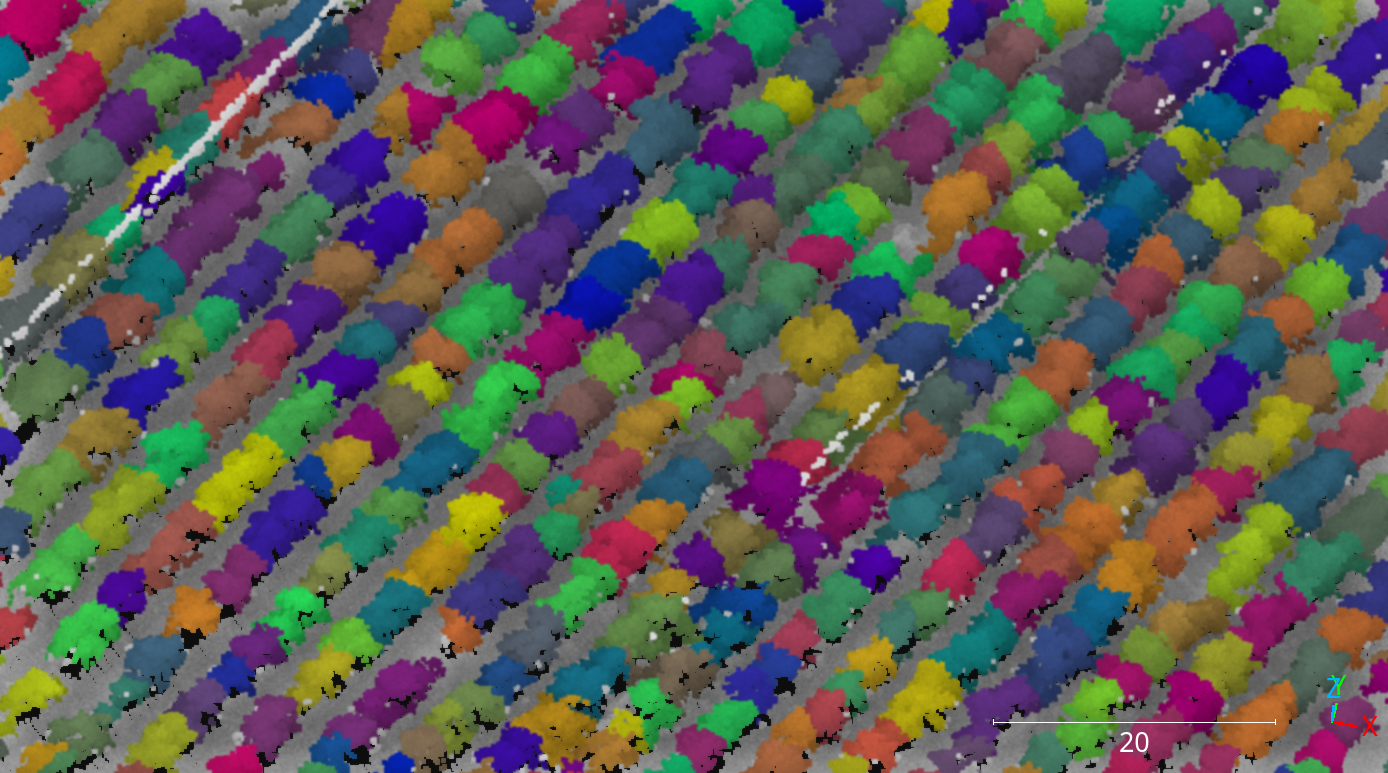
Visualization of the avocado clusters computed through the bivariate critical clustering algorithm with the region growing strategy.
Simple features clusterer
The SimpleFeaturesClusterer can be used to compute clusters by
filtering points considering relational conditions. These relationals can be
specified similar to how it is done for
the cluster selector post-processor. The JSON
below shows how to define a simple features clusterer:
{
    "clustering": "SimpleFeatures",
    "cluster_name": "change_cluster",
    "cluster_value": 1,
    "filters": [
        {
            "attribute": "chg_euclid",
            "relational": "greater_than_or_equal_to",
            "target": 0.33,
            "action": "preserve"
        }
    ]
}
The JSON above defines a SimpleFeaturesClusterer that makes a cluster
with all the points that have Euclidean distance-based point-wise change
quantification greater than \(0.33\) meters. The points that do not belong
to the cluster will have a value of zero, those that belong to the cluster will
have a value of one. The name of the feature representing the cluster is
"change_cluster".
Arguments
- –
cluster_name The name of the feature representing the cluster.
- –
cluster_value The value for the points that belong to the cluster.
- –
filters
Simple curve extractor
The SimpleCurveExtractor extracts clean, parameterized 3D curves
from previously classified or clusterized point clouds. It implements a
6-stage pipeline: adaptive stabilization, soft 2.5D skeleton extraction,
monotonic topological pruning, resilient geometry refinement, multi-format
output, and optional reverse label propagation. The JSON below shows how to
define a simple curve extractor:
{
    "clustering": "SimpleCurveExtractor",
    "cluster_name": "CURVE",
    "curve_source": "classification",
    "curve_classes": [4],
    "min_voxel_size": 0.1,
    "merge_radius": 15.0,
    "z_tolerance": 2.0,
    "min_segment_length": 3.0,
    "spatial_scale": 1.5,
    "min_curve_length": null,
    "min_twig_length": null,
    "rdp_tolerance": null,
    "curve_pcloud_step": null,
    "snap_densify_step": null,
    "snap_max_shift": null,
    "snap_target_radius": null,
    "snap_pull_radius": null,
    "hallucination_drop_densify_step": null,
    "hallucination_drop_radius": null,
    "hallucination_min_supported_length": null,
    "endpoint_extension_step": null,
    "endpoint_extension_radius": null,
    "endpoint_extension_max_length": null,
    "cid_relabel_z_disjoint_threshold": null,
    "cid_gap_split_dz_threshold": null,
    "max_merge_iterations": 3,
    "tangent_smoothing_iterations": 3,
    "occupancy_threshold": 0.1,
    "chain_radius_factor": 3.0,
    "angular_threshold_k": 1.5,
    "betweenness_percentile": 0.05,
    "ridge_fraction": 0.5,
    "output_point_spacing": 0.0,
    "z_consistency_sigma": 0.0,
    "snap_enable": true,
    "snap_min_neighbors": 4,
    "snap_smoothing_iterations": 2,
    "snap_passes": 30,
    "snap_post_passes": 20,
    "hallucination_drop_enable": true,
    "hallucination_drop_threshold": 0.025,
    "snap_truncate_iterations": 15,
    "endpoint_extension_enable": true,
    "cid_relabel_z_disjoint_enable": true,
    "cid_gap_split_enable": true,
    "cid_gap_split_planar_radius": 15.0,
    "merge_orphans_enable": true,
    "final_cleanup": false,
    "slope_output_form": "angle_deg",
    "propagate_labels": true,
    "curve_pcloud": "*/curve_pcloud.las",
    "output_gpkg": "*/break_curves.gpkg",
    "output_shp": "*/break_curves.shp",
    "output_csv": "*/break_curves.csv",
    "epsg": 25829,
    "nthreads": -1,
    "post_clustering": null
}
The JSON above defines a SimpleCurveExtractor that will extract
3D curves from points classified as class \(3\) (e.g., roads). The
adaptive stabilization will run up to \(3\) merge iterations with
\(3\) tangent smoothing iterations. The skeleton will be extracted
using a z_tolerance of \(2.0\) (soft-Z sigma) and an occupancy
threshold of \(0.1\). Topological pruning removes twigs shorter
than \(50 \times \text{min_voxel_size}\) (i.e. \(5.0\) m at
the default voxel size) and prunes low-centrality edges below the
\(5\)-th percentile. The final geometry is simplified with an RDP
tolerance derived from min_voxel_size (\(0.1\) m by default).
Extracted curves will be exported to GeoPackage, Shapefile, and CSV
formats in the EPSG:25830 coordinate reference system. Computations
will use all available cores.
Example configuration notes:
All hidden/advanced kwargs are listed at their default values so the JSON above can be used as a “copy this, customise the line you care about” template.
rdp_toleranceandmin_twig_lengthuse the sentinelnull. When omitted (ornull) they are derived frommin_voxel_sizeso they track the input coordinate scale (see their individual argument entries for the derivation).snap_densify_step,hallucination_drop_densify_step, andendpoint_extension_steplikewise use the sentinelnull. When unset they each resolve to \(5 \times \text{min_voxel_size}\) (i.e. \(0.5\) m at the default voxel size), matching the densification step on the production fixture.cid_gap_split_planar_radiusalso defaults tonulland resolves tomerge_radiuswhen the latter is set. Ifmerge_radiusis itselfnullit falls back to the default \(15.0\) m so the gap-split pass keeps its metric-aligned planar radius.
Note
Some kwargs use the sentinel null and resolve at instance
construction to a fixed coefficient times min_voxel_size so the
algorithm scales with the input voxel resolution.
min_twig_length– \(50 \times \text{min_voxel_size}\)(= \(5.0\) m at default).
rdp_tolerance– \(\text{min_voxel_size}\)(= \(0.1\) m at default).
min_curve_length– \(500 \times \text{min_voxel_size}\)(= \(50.0\) m at default).
curve_pcloud_step– \(1 \times \text{min_voxel_size}\)(= \(0.1\) at default).
snap_densify_step– \(5 \times \text{min_voxel_size}\)(= \(0.5\) m at default).
snap_max_shift– \(35 \times \text{min_voxel_size}\)(= \(3.5\) m at default).
snap_target_radius– \(30 \times \text{min_voxel_size}\)(= \(3.0\) m at default).
snap_pull_radius– \(400 \times \text{min_voxel_size}\)(= \(40.0\) m at default).
hallucination_drop_densify_step– \(5 \times \text{min_voxel_size}\)(= \(0.5\) m at default).
hallucination_drop_radius– \(25 \times \text{min_voxel_size}\)(= \(2.5\) m at default).
hallucination_min_supported_length– \(1 \times \text{min_voxel_size}\)(= \(0.1\) m at default).
endpoint_extension_step– \(5 \times \text{min_voxel_size}\)(= \(0.5\) m at default).
endpoint_extension_radius– \(25 \times \text{min_voxel_size}\)(= \(2.5\) m at default).
endpoint_extension_max_length– \(150 \times \text{min_voxel_size}\)(= \(15.0\) m at default).
cid_relabel_z_disjoint_threshold– \(50 \times \text{min_voxel_size}\)(= \(5.0\) m at default).
cid_gap_split_dz_threshold– \(30 \times\text{min_voxel_size}\)(= \(3.0\) m at default).
Arguments
Input configuration
- –
curve_source The source attribute from which curve points are selected. It can be
"classification"to use the point cloud’s classification attribute,"predictions"(or equivalently"prediction") to use predicted labels, or any custom attribute name to access an extra dimension by name from the LAS structure. The three built-in keywords ("classification","prediction","predictions") are matched case-insensitively; a custom attribute name is passed through verbatim to the LAS-dimension lookup and is therefore case-sensitive. When the predictions array is two-dimensional and of a floating-point dtype (i.e. per-class probabilities), hard labels are derived via \(\operatorname{argmax}\) along the class axis.- –
curve_classes A list of integer class or cluster IDs that identify curve points. All points whose
curve_sourceattribute matches one of these values will be used as input for the curve extraction pipeline.
Stage 1: Adaptive stabilization
- –
max_merge_iterations The maximum number of convergence iterations for the adaptive stabilization stage. During each iteration, disconnected endpoint pairs are scored and merged when their combined distance, tangent alignment, and component size score exceeds the acceptance threshold. Default is \(3\).
- –
tangent_smoothing_iterations The number of iterations for tangent field smoothing within the stabilization stage. Higher values produce smoother tangent estimates at the cost of reduced locality. Default is \(3\).
- –
min_voxel_size The minimum allowed voxel size for adaptive voxelization. Prevents pathological cases where duplicate points or noise produce an extremely small median nearest-neighbor distance. The actual voxel size is computed as \(V = \max(1.5 \times \text{median_nn}, \text{min_voxel_size})\).
min_voxel_sizealso acts as the reference scale for several scale-coupled downstream thresholds (min_twig_length,rdp_tolerance, the \(\Delta z_{\max}\) floor, and the Z-jump bridge floor), so pick a value consistent with the input coordinate scale. Default is \(0.1\).
Stage 2: Soft 2.5D skeleton extraction
- –
z_tolerance Soft-Z sigma \(\sigma_z\) used by the occupancy weighting. It controls the Gaussian weighting of point heights when building the 2.5D occupancy grid: \(\text{occupancy}(\text{cell}) = \sum_i \exp\left(-\frac{(Z_i - Z_{\text{ref}})^2}{2\,\sigma_z^2}\right)\). This parameter also governs the maximum Z-difference threshold \(\Delta z_{\max}\) used by the cylindrical merge criterion and the three Z-artifact detectors (bridge Z-jump split, vertical column split, Z-reversal split; see
merge_radius). Default is \(2.0\).- –
occupancy_threshold The binary threshold applied to the soft-Z occupancy values. Cells with occupancy below this threshold are considered unoccupied. Default is \(0.1\).
- –
spatial_scale The skeleton-extraction voxel size, independent of the stabilization voxel size. When set to \(0.0\) (default), the stabilization voxel size is used. For wide curves (e.g., roads), setting this to a value larger than the default (e.g., \(1.0\)–\(2.0\) meters) produces cleaner centerlines by reducing the skeleton grid resolution.
- –
merge_radius The endpoint merge radius. When set (not
null), endpoint pairs are tested against a cylindrical proximity criterion: the 2D (XY-plane) distance must be within the merge radius \(r_m\), and the absolute Z-difference must not exceed a maximum threshold \(\Delta z_{\max}\):\[\| \mathbf{p}_a^{xy} - \mathbf{p}_b^{xy} \|_2 \;\le\; r_m \qquad\text{and}\qquad | z_a - z_b | \;\le\; \Delta z_{\max}\]where the Z-difference threshold is derived from
z_tolerance:\[\Delta z_{\max} = \max\!\bigl(\min(3\,\sigma_z,\; r_m),\; 10 \times \text{min_voxel_size}\bigr)\]The \(\max(\cdot,\, 10\,V_{\min})\) floor prevents degenerate behaviour when \(\sigma_z = 0\) and scales with
min_voxel_sizeso the threshold is portable across coordinate scales (metre, sub-metre, or very-large clouds). At the defaultmin_voxel_size = 0.1the floor is \(1\,\text{m}\), matching the legacy metre-scale behaviour. This cylindrical test is used in three stages: endpoint merging (connecting different curve components), post-chain merging (reconnecting same-curve segments), and post-resolve merging (reconnecting endpoints created by cross-feature truncation).Three post-processing artifact detectors are derived from \(\Delta z_{\max}\) to remove elevation artifacts produced by multi-terrace skeleton connections:
Bridge Z-jump split. Operates on each polyline using the consecutive XY spacings \(\Delta xy_k\) and their median \(\widetilde{\Delta xy}\). A segment \(k\) is flagged as a Z-jump bridge when either of two criteria holds.
The moderate-bridge criterion flags short gaps with a large vertical jump:
\[\Delta xy_k > \max\!\bigl(3\,\tilde{\Delta xy},\; 10 \times \text{min_voxel_size}\bigr) \quad\text{and}\quad |\Delta z_k| > \max\!\left( \frac{\Delta z_{\max}}{2},\; 1\right)\]The \(\max(\cdot, 10\,V_{\min})\) XY floor and the \(\max(\cdot, 1)\) Z floor prevent degenerate thresholds when the polyline is very tight or \(\Delta z_{\max}\) is small. The Z floor of \(1\) is an absolute constant from the code and does not scale with
min_voxel_size.The long-bridge criterion flags long gaps with a moderate vertical jump:
\[\Delta xy_k > \ell_{xy} \quad\text{and}\quad |\Delta z_k| > \ell_z\]where the thresholds track the pipeline’s spatial and Z-noise scales:
\[\begin{split}\ell_{xy} = \begin{cases} \tfrac{2}{3}\,r_m & \text{if } r_m > 0 \\ 10 & \text{otherwise} \end{cases} \qquad \ell_z = \begin{cases} \sigma_z & \text{if } \sigma_z > 0 \\ 2 & \text{otherwise} \end{cases}\end{split}\]At the legacy test defaults (\(r_m = 15\), \(\sigma_z = 2\)) these recover \(\ell_{xy} = 10\,\text{m}\) and \(\ell_z = 2\,\text{m}\).
Flagged indices split the polyline into independent sub-features; the short arc immediately surrounding the jump is then removed by the
min_curve_length/ short-curve-artifact filter downstream.Vertical column split. A windowed grade analysis detects contiguous runs where Z changes rapidly relative to 2D movement. Let \(N\) be the number of polyline vertices and \(w = \min(100,\, \lfloor N/4 \rfloor)\); the detector is only engaged when \(w \ge 10\). For each window start \(i\) the grade is
\[G_w(i) = \frac{|z_{i+w} - z_i|} {\max\!\bigl(\sum_{k=i}^{i+w-1} \Delta xy_k,\; 0.1\bigr)}\]Let \(I = \{i : G_w(i) > \tan(\theta)\}\) be the set of vertical-grade hits. Consecutive hits are grouped into runs: two successive indices \(i_j,\, i_{j+1} \in I\) belong to the same run when \(i_{j+1} - i_j \le w\); a gap \(> w\) starts a new run. For each run the polyline is split both at the run-start index \(i_{\text{start}}\) and at \(i_{\text{end}} + w\) (clamped to the polyline’s interior), so the vertical column is isolated as a short sub-feature the downstream
min_curve_length/ short-curve-artifact filter then drops. Here \(\theta\) is fixed at \(\pi/4\) (giving \(\tan(\theta) = 1\) — steeper than \(45^{\circ}\)).Z-reversal split. A drawdown analysis detects features whose elevation profile climbs to an interior peak and then drops by more than \(\Delta z_{\max}\):
\[D(i) = \max_{j \le i} z_j \;-\; z_i \qquad\Longrightarrow\qquad \text{split where } D(i) > \Delta z_{\max}\]The feature is split at the peak preceding the excessive drawdown. Peaks at the very start or end of the feature (monotonic descents) are not considered reversals.
When
null(default) or set to a non-positive value, no merging or artifact splitting is performed — the internal enable flag ismerge_radius is not None and merge_radius > 0.
Stage 3: Monotonic topological pruning
Stage 3 operates on the skeleton graph \(G = (V, E)\) produced by Stage 2 — an undirected radius graph whose nodes are the extracted skeleton points and whose edges connect skeleton points that were judged topologically adjacent. Given a node \(i \in V\), we write \(\deg(i)\) for its degree (the number of edges incident to \(i\) in \(E\)) and \(\mathcal{N}(i)\) for its neighbor set; these are the only graph primitives the rest of the stage relies on. Stage 3 runs four sequential operations — twig pruning, junction detection, betweenness-based chain pruning, and cycle validation — each of which consumes the output of the previous step.
- –
min_twig_length Minimum length (in point-cloud units) of a twig — a chain of degree-2 nodes emanating from a degree-1 endpoint — below which the twig is removed. Twig tracing, implemented in
TopologicalPruner::pruneTwigs, starts from every node \(e\) with \(\deg(e) = 1\) and walks the unique chain \(e = v_0 \to v_1 \to \dots \to v_m\) through degree-2 nodes, stopping at the first stop node — either a junction (flagged byangular_threshold_kbelow), a graph boundary, or another degree \(\ne 2\) node. The twig length is its cumulative Euclidean arc length\[L(v_0,\dots,v_m) = \sum_{k=0}^{m-1} \bigl\lVert \mathbf{x}_{v_{k+1}} - \mathbf{x}_{v_k}\bigr\rVert_2.\]If \(L < \text{min_twig_length}\), every edge along the chain is removed from \(G\). Chains whose both endpoints are degree-1 are deduplicated (traced once) so they are not removed twice.
When set to
null(default) the value is derived as \(50 \times \text{min_voxel_size}\) (i.e. \(5.0\) at the default \(\text{min_voxel_size} = 0.1\)). The sentinel is resolved in__init__()and the derived value is whatpruneTwigsactually receives.- –
angular_threshold_k Robust multiplier \(k\) that selects which high-degree nodes are classified as junctions. The detector, in
TopologicalPruner::detectJunctions, proceeds as follows.Candidate set. Let \(C = \{ i \in V : \deg(i) \ge 3 \}\) be the set of candidate nodes. A degree-1 or degree-2 node cannot express branching, so it is never a junction candidate.
Per-node angular spread. For each candidate \(i \in C\), compute the unit directions from \(i\) to each of its neighbors,
\[\mathbf{d}_{i \to j} = \frac{\mathbf{x}_j - \mathbf{x}_i} {\lVert \mathbf{x}_j - \mathbf{x}_i\rVert_2}, \qquad j \in \mathcal{N}(i),\](neighbors at exactly the same position as \(i\) are discarded via a \(10^{-12}\) length check). The angular spread \(\alpha(i)\) is the maximum pairwise angle among those unit directions:
\[\begin{split}\alpha(i) = \max_{\substack{ j_1, j_2 \in \mathcal{N}(i) \\ j_1 < j_2}} \arccos\!\bigl( \mathbf{d}_{i \to j_1} \cdot \mathbf{d}_{i \to j_2} \bigr).\end{split}\]The dot product is clamped to \([-1, 1]\) before the \(\arccos\) to absorb floating-point drift. Candidates with fewer than two finite unit directions receive \(\alpha(i) = 0\).
Robust global threshold. Let \(m = \operatorname{median}_{i \in C}\alpha(i)\) and
\[s = \operatorname{median}_{i \in C} \bigl|\alpha(i) - m\bigr|\]be the median and median absolute deviation (MAD) of the candidate spreads. The junction threshold is
\[\tau_{\alpha} = m + k \cdot s.\]Using the MAD rather than the standard deviation makes \(\tau_{\alpha}\) robust to a handful of extreme Y-shaped splits that would otherwise inflate a mean/stddev estimate.
Flagging. A candidate \(i \in C\) is marked as a junction iff \(\alpha(i) > \tau_{\alpha}\). The resulting junction mask is consumed by
pruneTwigs(stop criterion) and by the segment/curve-ID assignment downstream.
Raising \(k\) makes the threshold stricter and produces fewer junctions — more branches are then treated as plain degree-2 chain vertices. Default is \(1.5\).
- –
betweenness_percentile Percentile cutoff \(p \in [0, 1]\) on edge betweenness centrality. For an undirected graph, Brandes’ (2001) unweighted edge betweenness is
\[\begin{split}c_B(e) = \sum_{\substack{s, t \in V \\ s \ne t}} \frac{\sigma_{st}(e)}{\sigma_{st}},\end{split}\]where \(\sigma_{st}\) is the number of shortest paths from \(s\) to \(t\) and \(\sigma_{st}(e)\) is the number of those paths that traverse edge \(e\). Shortest is measured by hop count: every edge has unit length. Intuitively, \(c_B(e)\) counts how often \(e\) appears on a shortest path between arbitrary pairs of nodes — bridge-like edges on the backbone of \(G\) score high, peripheral side-roads score low.
Brandes’ algorithm computes all \(c_B(e)\) in \(O(|V|\,|E|)\) total. For each chosen source \(s \in V\), a single breadth-first search (BFS) from \(s\) populates four arrays over nodes \(v \in V\):
\(d_s(v)\) — the number of edges on a shortest \(s \to v\) path;
\(\sigma_s(v)\) — the count of shortest \(s \to v\) paths, accumulated during the BFS layer sweep via \(\sigma_s(w) \mathrel{+}= \sigma_s(v)\) whenever \(d_s(w) = d_s(v) + 1\) and \(w \in \mathcal{N}(v)\);
\(P_s(v)\) — the list of predecessors of \(v\) on its shortest paths from \(s\);
\(\delta_s(v)\) — the source-dependent dependency of \(v\), computed bottom-up after the BFS in decreasing-\(d_s\) order by
\[\delta_s(v) = \sum_{w : v \in P_s(w)} \frac{\sigma_s(v)}{\sigma_s(w)} \bigl(1 + \delta_s(w)\bigr).\]
The edge dependency contributed by source \(s\) to edge \((v, w)\) with \(v \in P_s(w)\) is \((\sigma_s(v)/\sigma_s(w))\,(1 + \delta_s(w))\), and the final edge centrality is the sum over all chosen sources \(s\). (Breadth-first search, BFS, is the canonical graph traversal that visits all nodes at hop distance 1 from the source first, then all at hop distance 2, and so on; it yields shortest-path distances in unweighted graphs in \(O(|V| + |E|)\) per source.)*
Where the centrality is computed. Running Brandes’ on the raw skeleton graph is wasteful because every degree-2 chain adds redundant edges that all carry the same score. Stage 3 therefore first contracts the graph: each maximal degree-2 chain between two non-degree-2 endpoints \(a, b\) collapses to a single edge \((a, b)\) in a contracted graph \(\tilde{G}\), with that edge’s weight irrelevant for the BFS (edges are still unit-length during the shortest-path computation). Centrality is then computed on \(\tilde{G}\), the score of each contracted edge is mapped back to all the original edges along the corresponding chain, and the pruning threshold is applied in the original graph.
Pruning. Let \(c_{(1)} \le c_{(2)} \le \dots \le c_{(M)}\) be the contracted-edge scores sorted ascending (one score per contracted edge, \(M\) =
contractedChainCount). The code selects the threshold index\[\operatorname{pIdx} = \lfloor p \cdot (M-1) \rfloor \in \{0, 1, \dots, M-1\},\](0-based, clamped to \(M-1\)) and sets \(\tau_B = c_{(\operatorname{pIdx} + 1)}\) (1-based order statistic), which is the standard left-tail percentile estimate for sample size \(M\). Every original edge whose corresponding contracted edge has score \(c \le \tau_B\) is removed from \(G\).
The \(\le\) comparison has two notable edge cases:
\(p = 0\) does not disable the prune. With \(\operatorname{pIdx} = 0\), \(\tau_B = c_{(1)} = \min_i c_i\), so the minimum-score edge is removed and all other edges tied with that minimum are removed as well. In a graph with no ties at the minimum, exactly one contracted edge (and all original edges it represents) is pruned per pass.
\(p = 1\) gives \(\tau_B = c_{(M)} = \max_i c_i\), so every contracted edge satisfies \(c \le \tau_B\) and the entire backbone is stripped. This is degenerate and is not a supported operating point.
With \(p = 0.05\) (default), roughly the bottom 5 % of backbone edges are pruned each pass. Default \(p = 0.05\).
- –
ridge_fraction Relative distance-transform (DT) threshold used to validate (or break) cycles in the pruned graph. Each skeleton node \(v\) inherits from Stage 2 a scalar DT value \(dt(v) \ge 0\) produced by the exact Felzenszwalb-Huttenlocher 2D Euclidean Distance Trasnsform (EDT) on the soft-Z binary occupancy grid. The EDT is seeded on background (unoccupied) cells (the standard medial-axis convention), so if \(\mathrm{cell}(v)\) is the 2D voxel containing \(v\) and \(B\) is the set of background cells of the pre-thinning occupancy grid, each cell \(q\) is assigned
\[E^2(q) = \min_{p \in B}(q - p)^2,\]and the per-node DT is
\[dt(v) = \sqrt{E^2\!\bigl(\mathrm{cell}(v)\bigr)} \cdot V,\]where \(V\) is the voxel size. The
validateCycleshelper consumes these values verbatim. Because skeleton nodes are, by construction, interior points of the occupied region surviving Zhang-Suen thinning, they sit at positive \(dt\): thick medial ridges carry large values, boundary-adjacent nodes carry small ones. A genuine ridge-like curve therefore has uniformly high \(dt\) along its length; spurious loops closed across narrow chokepoints contain at least one node whose \(dt\) is comparatively small.Let \(m_{dt} = \operatorname{median}_{v \in V} dt(v)\) and define the global DT threshold
\[\tau_{dt} = \text{ridge_fraction} \cdot m_{dt}.\]Cycles are discovered by an iterative (stack-based) depth-first traversal of the currently active subgraph (\(\deg(v) > 0\) nodes). The implementation does not maintain the classical discovery/finish-time coloring, so “back edge” here is a DFS-tree heuristic: an edge \((u, v)\) examined during traversal is flagged when
\[v \in \operatorname{visited} \quad\text{and}\quad v \neq \operatorname{parent}(u) \quad\text{and}\quad \operatorname{depth}(v) < \operatorname{depth}(u),\]i.e. it re-enters an already-visited node that is not the parent in the DFS tree and that lies at a strictly smaller DFS depth. On a plain undirected graph traversed with an explicit stack this captures the typical cycle-closing edges without the overhead of the two-color scheme. Let \(C\) be the cycle this back edge closes, reconstructed by walking the DFS parent pointers from \(u\) back to \(v\). The cycle is characterised by its minimum edge DT
\[\operatorname{minDT}(C) = \min_{(a, b) \in C} \min\!\bigl(dt(a),\, dt(b)\bigr),\]i.e. the DT of the weakest edge along \(C\) (edge DT is defined as the minimum of its two endpoint DTs). If \(\operatorname{minDT}(C) < \tau_{dt}\) the cycle is flagged as spurious — at least one of its edges is too close to the boundary to represent a real loop — and the weakest edge of \(C\) (the \((a, b) \in C\) achieving the \(\operatorname{minDT}\)) is removed, breaking the cycle. If \(\operatorname{minDT}(C) \ge \tau_{dt}\), the cycle is preserved.
Raising
ridge_fractionmakes \(\tau_{dt}\) larger relative to the median, so more cycles fail the check and are broken; lowering it preserves more cycles. With the default \(0.5\), a cycle must have every edge at DT no smaller than half the median nodal DT to survive.Operating regime. Zhang-Suen thinning preserves only cells that retain at least one background neighbour, so every surviving skeleton cell is at squared cell-distance \(\ge 1\) from the nearest background cell. Scaled by the voxel size this gives a hard lower bound
\[\min_{v} dt(v) \;\ge\; V,\]i.e. the smallest per-node DT is at least the voxel size \(V\) (
spatial_scalewhen set, otherwise the Stage-1 adaptive voxel size). Because \(\tau_{dt} = \text{ridge\_fraction} \cdot m_{dt}\) must exceed \(\min_v dt(v) \ge V\) for any cycle edge to qualify for removal, the effective no-fire threshold is\[\text{ridge\_fraction} \;\lesssim\; \frac{V}{m_{dt}}.\]On typical breakline inputs \(m_{dt}\) sits roughly at \(1.4\,V\) (so \(V / m_{dt} \approx 0.7\)), which means the documented default \(0.5\) is effectively a no-op for cycle validation on those inputs — the step becomes active only once \(\text{ridge\_fraction} \gtrsim 0.7\). The practical useful band is narrow and data-dependent (typically \([0.8,\, 1.0]\)); values above \(\approx 1.0\) tend to remove cycle edges that are load-bearing in the final polyline chaining and introduce gaps and near self-intersections downstream. Sweep a handful of values for a new input if you need cycle validation to fire; otherwise leave at the default and rely on the twig-pruning and betweenness-pruning stages to handle spurious topology.
Stage 4: Resilient geometry refinement
- –
rdp_tolerance The tolerance for Ramer-Douglas-Peucker (RDP) simplification, in point cloud units. Larger values produce fewer output points. When set to
null(default) the value is derived as \(\text{rdp_tolerance} = 1 \times \text{min_voxel_size}\) (i.e. \(0.1\) at the default voxel size). It is kept as a separate attribute so it can be tuned independently frommin_voxel_sizeif the application requires a different simplification scale.- –
output_point_spacing The target spacing for PCHIP resampling of the final curves. Each segment will be resampled to \(\max(3, \lceil L / \text{spacing} \rceil)\) points, where \(L\) is the arc length. When set to \(0.0\), the spacing is automatically derived from the voxel size computed during stabilization. Default is \(0.0\).
- –
z_consistency_sigma The width of the 1D Gaussian filter applied along the arc-length of each segment to enforce Z consistency. Prevents grade drift in sparse regions. When set to \(0.0\), the width is automatically computed as \(5 \times \text{voxel_size}\). Default is \(0.0\).
Post-filtering
- –
min_segment_length The minimum 3D arc-length for a curve segment to be retained in the output. Segments shorter than this value are discarded after geometry refinement. Useful for removing small fragments from noisy skeletons. When set to \(0.0\) (default), no filtering is applied.
- –
chain_radius_factor Multiplier applied to the skeleton voxel size to compute the chain radius for connecting adjacent segments into continuous polylines. The chain radius is \(r_c = \text{chain_radius_factor} \times V_s\) where \(V_s\) is the skeleton voxel size (
spatial_scale). Segment endpoints are tested using the same cylindrical proximity criterion asmerge_radius, with the chain radius \(r_c\) as the 2D threshold and \(\Delta z_{\max} = \max\!\bigl(\min(3\,\sigma_z,\; 2\,r_c),\; 10 \times \text{min_voxel_size}\bigr)\) as the Z-difference bound. Default is \(3.0\).- –
min_curve_length The minimum arc-length for a curve to be retained in the final output. Curves whose arc-length is below this value are discarded after all chaining, merging, and geometric cleanup. Arc-length is measured as the 2D (XY-plane footprint) length \(L_{\text{2D}}\). For a polyline with \(N\) vertices \(\mathbf{p}_1, \ldots, \mathbf{p}_N\), the 2D arc-length (XY-plane footprint) is
\[L_{\text{2D}} = \sum_{i=1}^{N-1} \sqrt{(x_{i+1}-x_i)^2 + (y_{i+1}-y_i)^2}\]and the 3D arc-length (full Euclidean) is
\[L_{\text{3D}} = \sum_{i=1}^{N-1} \sqrt{(x_{i+1}-x_i)^2 + (y_{i+1}-y_i)^2 + (z_{i+1}-z_i)^2}\]In regions where the Z coordinate oscillates (e.g., due to noisy PCHIP interpolation in steep terrain), \(L_{\text{3D}}\) can be significantly larger than \(L_{\text{2D}}\), causing visually short curves to survive the filter. For this reason the default metric is \(L_{\text{2D}}\). When set to \(0.0\) no curve-level filtering is applied (and the
adopt-short-CIDspass is also disabled). Defaultnull(sentinel) – derived as \(500 \times \text{min_voxel_size}\) at instance construction (= \(50.0\) m at the productionmin_voxel_size = 0.1fixture, matching the inicorta-tuned value). Note:min_curve_lengthis scene-coupled (depends on the characteristic length of the curves being extracted), not just scale-coupled; override explicitly when the scene’s curve-length distribution differs from inicorta’s. The kwarg is also load-bearing for theadopt-short-CIDspass (gated bymin_curve_length > 0), so changing it can alter intermediate CID groupings, not just the final filter.
Snap-to-input pass
After the chain-merge cascade and resilient geometry refinement,
the snap-to-input pass shifts interior polyline vertices toward
the input curve-class points the extraction missed. Endpoints
are deliberately never moved. The pass runs in two stages: a pre-sanitise pulse
of snap_passes and a post-sanitise pulse of
snap_post_passes. The sanitiser between them clips
loop-prone polyline material and the post-pulse re-fits the
clipped polylines toward newly-missed points.
- –
snap_enable When
true(default) the snap-to-input pass is active.- –
snap_max_shift Maximum 2D distance (in metres) a single interior vertex can be shifted in one snap pass. Smaller caps reduce the number of near-self-crossings the sanitiser later clips, which in turn preserves more coverage. Default
null(sentinel) – derived as \(35 \times \text{min_voxel_size}\) at instance construction.- –
snap_min_neighbors Minimum number of missed input points that must pull a given interior vertex before that vertex is shifted. Acts as a sparsity filter that suppresses noisy single-point pulls. Default \(4\).
- –
snap_smoothing_iterations Number of 3-point moving-average passes applied to the per-vertex delta sequence before the shifts are committed. Prevents adjacent vertices from shifting in opposing directions. Default \(2\).
- –
snap_target_radius Coverage radius (m) used to classify input points as MISSED (eligible to pull a vertex). A curve-class input point is MISSED iff its distance to every densified polyline vertex exceeds this radius. Default
null(sentinel) – derived as \(30 \times \text{min_voxel_size}\) at instance construction.- –
snap_pull_radius Maximum distance (m) from a missed point to its nearest interior polyline vertex; missed points farther than this are ignored. Larger values pull more distant misses toward their nearest polyline; gain saturates once this exceeds typical inter-cluster spacing. Default
null(sentinel) – derived as \(400 \times \text{min_voxel_size}\) at instance construction.- –
snap_densify_step Spacing (m) of the densified polyline used to classify input points as covered or missed. When set to
null(default) the value is derived as \(5 \times \text{min_voxel_size}\) (i.e. \(0.5\) m at the default voxel size).- –
snap_passes Number of times the snap pass is applied BEFORE the H25 sanitiser. Each pass re-evaluates which input points are still MISSED, so successive passes progressively close the remaining coverage gap. Default \(30\).
- –
snap_post_passes Number of additional snap passes applied AFTER the sanitiser. The sanitiser clips loop-prone polyline material the pre-sanitise snap may have created; the post-pass re-fits the clipped polylines toward newly-missed points. The per-polyline SI guard prevents any post-pass shift from introducing new self-crossings. Setting to \(0\) reproduces the snap behaviour. Default \(20\).
Hallucination-drop and snap/truncate iteration
After all snap passes, a hallucination-drop pass identifies and truncates polyline material with no input curve-class support. The snap/truncate iteration loop then alternates one snap pass and one drop pass for several cycles, so coverage gains from the snap compound while the hallucination invariant is preserved (no hallucinated material survives any cycle).
- –
hallucination_drop_enable When
true(default), every feature whose hallucinated polyline length exceedshallucination_drop_thresholdof its total length is dropped at the end of the global-optimisation step. Hallucinated material is polyline length without any input curve-class support withinhallucination_drop_radius.- –
hallucination_drop_radius Neighbourhood radius (m) used to classify a densified polyline vertex as supported. Default
null(sentinel) – derived as \(25 \times \text{min_voxel_size}\) at instance construction.- –
hallucination_drop_threshold Per-feature hallucination ratio above which the feature is truncated at its hallucinated runs (or dropped if no supported run survives). Default \(0.025\) – identical to the validation metric’s
--hallucination-feature-threshold.- –
hallucination_drop_densify_step Polyline densification step (m) used to compute the per-feature hallucination ratio. When set to
null(default) the value is derived as \(5 \times \text{min_voxel_size}\) (i.e. \(0.5\) m at the default voxel size), matching the validation metric’s densification step.- –
hallucination_min_supported_length Minimum length (m) of a supported sub-polyline kept when a hallucinated feature is split. Hallucinated features above the per-feature threshold are truncated at their hallucinated runs; each contiguous supported run becomes a new feature, but only if its 2D length is at least this many metres. Shorter supported runs are discarded. Default
null(sentinel) – derived as \(1 \times \text{min_voxel_size}\) at instance construction.- –
snap_truncate_iterations Number of snap/truncate cycles run after the initial truncation pass. Each cycle performs one
_snap_polylines_to_input()followed by one_drop_hallucinated_features()so coverage gains from snap shifts compound without ever leaving hallucinated material in the output. Default \(15\) – empirically saturates the residual coverage budget at modest runtime cost.
Endpoint-extension pass
After the snap-truncate loop saturates, a few input points
remain MISSED just past the polyline endpoints because the
snap pass deliberately never moves endpoints. The endpoint-
extension pass walks each endpoint outward along its tangent
in steps of endpoint_extension_step while the next step
still has at least one input curve-class point within
endpoint_extension_radius. The walk stops at the first
unsupported step or after endpoint_extension_max_length
metres, so by construction the extension never introduces
hallucinated material.
- –
endpoint_extension_enable When
true(default) the endpoint-extension pass is active. The pass cannot introduce hallucinated material because it stops at the first unsupported step. Defaulttrue.- –
endpoint_extension_radius Neighbourhood radius (m) used to test whether a candidate extension point is supported by the input cloud. Default
null(sentinel) – derived as \(25 \times \text{min_voxel_size}\) at instance construction.- –
endpoint_extension_step Distance (m) between successive extension steps. Smaller values track curved input clusters more precisely; larger values are faster. When set to
null(default) the value is derived as \(5 \times \text{min_voxel_size}\) (i.e. \(0.5\) m at the default voxel size).- –
endpoint_extension_max_length Maximum extension length (m) per endpoint. Caps the walk so a particularly long stretch of supported material does not run away. Default
null(sentinel) – derived as \(150 \times \text{min_voxel_size}\) at instance It should be long enough to add meaningful coverage past saturated endpoints. The per-step crossing guard (with in-walk segment registration) plus the post-extension truncation pass keep self-intersections at zero, gaps at zero, and hallucinated features at zero even at this length.
z-disjoint CID relabel
After hallucination-drop, any CURVE_ID that still groups two
or more features whose z-extents are separated by more than
cid_relabel_z_disjoint_threshold metres is broken into
multiple CURVE_IDs (one per connected z-component). This
eliminates phantom gap pairs that arise when split-z-jump or
split-z-reversal cuts a polyline into vertically disjoint halves
but leaves both halves with the original CURVE_ID.
- –
cid_relabel_z_disjoint_enable When
true(default) the z-disjoint CID relabel pass is active. Eliminates phantom same-CID gap pairs left behind by Z-jump and Z-reversal splits. Defaulttrue.- –
cid_relabel_z_disjoint_threshold Z separation (m) above which two features sharing a
CURVE_IDare considered disjoint and split apart into twoCURVE_IDs. Defaultnull(sentinel) – derived as \(50 \times \text{min_voxel_size}\) at instance construction . Well abovez_tolerance(so legitimate Z-noise stays grouped) and well below the observed bad-pair gap on the production fixture.
Endpoint-pair gap splitter
After all geometry passes, this final pass splits any same-CID
feature pair whose closest endpoints are within
cid_gap_split_planar_radius in 2D AND more than
cid_gap_split_dz_threshold apart in elevation. The metric
counts such pairs as gaps, but the existing z-disjoint relabel
only fires when the features’ z-extents are fully disjoint;
the endpoint-pair splitter closes the loophole where a polyline
dips below another within the cluster but emerges with
z-disjoint endpoints.
- –
cid_gap_split_enable When
true(default) the endpoint-pair gap splitter is active. Defaulttrue.- –
cid_gap_split_planar_radius Maximum 2D distance (m) between the closest endpoints of two same-CID features for the pair to be considered a candidate gap. When set to
null(default) the value is derived frommerge_radius(\(R_{\text{merge}}\) when set, else \(15.0\) m fallback) so the planar threshold tracks the metric’s gap radius.- –
cid_gap_split_dz_threshold Minimum \(|\Delta z|\) (m) between the closest endpoints of two same-CID features for the pair to be flagged as a vertical gap and split apart. Default
null(sentinel) – derived as \(30 \times \text{min_voxel_size}\) at instance construction.
Orphan-fragment merge
Final cleanup pass that reassigns short whole-CID fragments to a
neighbouring CURVE_ID when they sit planar-close AND
z-overlapping with that neighbour. Geometry is never modified;
only the CID label of the orphan changes. Two safety nets prevent
undoing prior splits: the geometric guard (planar-close AND
z-overlap) is the strict negation of cid_relabel_z_disjoint_*
(which fires only on z-extent separation); and the length cap
prevents undoing the endpoint-pair splitter, which operates on
full-length features.
- –
merge_orphans_enable When
true(default) the orphan-fragment merge pass is active. Defaulttrue.
Final cleanup
Optional pass that runs at the tail of the global-optimization phase (after the post-optimization snap/sanitize/snap chain) and re-applies three cleanups whose first invocation in the pipeline ran before the merge and snap cascades and whose invariants the cascades can violate. The three operations are:
split_z_reversalsat the standard \(\Delta z_{\text{full}} = \mathtt{\_max\_dz}( \text{merge\_radius})\) threshold. The post-optimizationpost_chain_merge_until_stabledriver bridges same-CID features across different elevations and can introduce drawdowns far above the pre-merge split’s threshold.drop_cov_refine_by_predicatewith the cross-CID coverage-refine predicate. Snap shifts can drift coverage_refine helpers across an other-CID feature after the pre-snap drop already ran._relabel_disconnected_curves. Adoption can place a feature into aCURVE_IDwhose other members are withinmerge_radiusat the moment of adoption; subsequent endpoint extension and snap can then drift the components apart.
Between operations 1 and 2 the driver also drops post-split
sub-features whose 2D length falls below
min_segment_length (post-split tails shorter than the
SCE min-segment threshold).
The pass is off by default so production pipelines, the
SimpleCurveEvaluator workflow, and the bench probes
preserve their established behaviour exactly. The
SimpleCurveExtractionTest opts in
("final_cleanup": true) because its strict geometric
checks (cross-CID, disconnected components, z-reversals) are
not part of the production KPI set and thus tolerate the
small coverage / feature-count perturbations the cleanup can
introduce.
- –
final_cleanup When
true, run the optional final-cleanup cascade described above at the tail of the global-optimization phase. Whenfalse(default), the cascade is skipped and the global-optimization output is forwarded unchanged. Defaultfalse.
Output configuration
- –
output_gpkg The output path for the GeoPackage file. If
nullor not specified, no GeoPackage is written. The GeoPackage contains LineStringZ geometries with curve and segment metadata.- –
output_shp The output path for the Shapefile. If
nullor not specified, no Shapefile is written. The Shapefile contains PolyLineZ geometries (Shape Type 13) and produces.shp,.shx,.dbf, and.prjfiles.- –
output_csv The output path for the CSV file. If
nullor not specified, no CSV is written. The CSV contains per-point records with columnsCurveID,SegmentID,SequenceID,X,Y,Z, andSlope.- –
curve_pcloud The output path for the curve point cloud in LAS format. If
nullor not specified, no point cloud is written. When set, each curve is resampled along its arc-length atcurve_pcloud_stepspacing to produce \(N_i = \max\!\bigl(2,\, \lceil L_i / \Delta s \rceil + 1\bigr)\) points per curve, where \(L_i\) is the 3D arc-length and \(\Delta s\) iscurve_pcloud_step. Point coordinates are linearly interpolated along the arc parameterization \(\bigl(X(s),\, Y(s),\, Z(s)\bigr)\). The output LAS inherits the CRS from the input point cloud (via GeoTIFF VLRs) and always includesCURVE_ID(int32),SEG_ID(int32), andSLOPE(float64) as required extra dimensions, plus four length columnsCURVE_LENGTH_3D,CURVE_LENGTH_2D,SEG_LENGTH_3D,SEG_LENGTH_2D(allfloat32).CURVE_LENGTH_*carries the per-CURVE_IDtotal length broadcast to every point of every feature in that curve;SEG_LENGTH_*carries the per-feature length broadcast to every point of that feature.CURVE_IDandSEG_IDin the LAS are renumbered to contiguous, gap-free 0-based ranges immediately before writing.- –
curve_pcloud_step The distance between consecutive points in the curve point cloud, in the same spatial units as the input point cloud. Smaller values produce denser point clouds with finer curve representation. Default
null(sentinel) – derived as \(1 \times \text{min_voxel_size}\) at instance construction.- –
slope_output_form Output convention for the
SLOPEcolumn written by the curve point cloud. Internal computations always use the project- canonicalslope = dZ/ds_3D = sin(theta)(matchescomputeGradeincpp/src/alg/CurveSimplifier.tpp; bounded in \([-1, 1]\); well-defined on near-vertical segments). The writer can emit one of three conventions:"sin"(default) – emit the cached \(\sin(\theta) = dZ/ds_{\text{3D}}\) value. Bounded in \([-1, 1]\); uniform color ramp; the most stable form."tan"– recompute \(\tan(\theta) = dZ/dxy\) directly from the resampled output coordinates with a planar guard \(dxy \geq 10^{-9}\) and a magnitude clip at \(\pm 10^{6}\). Matches civil-engineering “grade”; can blow up on near-vertical sub-polylines (a \(89.99^\circ\) segment reads as \(\approx 5730\), crushing any color ramp)."angle_deg"– recompute the inclination angle in degrees as \(\arctan_2(dZ, dxy) \cdot 180 / \pi\). Unconditionally bounded in \([-90^\circ, +90^\circ]\); the most interpretable form for visualization in QGIS, CloudCompare, or any tool that maps a numeric column to a color ramp.
The
"tan"and"angle_deg"conventions recompute the slope directly from the output coordinates (rather than from the cached \(\sin\) via the analytical conversion \(\tan = \sin / \sqrt{1 - \sin^{2}}\)) to avoid catastrophic cancellation near vertical. Internal slope computations are not affected by this setting.- –
epsg The EPSG code for the coordinate reference system of the output files. If not specified, the CRS is inherited from the input LAS file.
- –
propagate_labels Whether to propagate curve and segment IDs back to the original point cloud (
true) or not (false). When enabled, each point in the original cloud receivescurve_idandsegment_idattributes via nearest-neighbor assignment from the extracted curves. Points farther than \(2 \times \text{voxel_size}\) remain unassigned. Disabled by default to save memory when only file outputs are needed.
General
- –
cluster_name The name for the cluster attribute in the output point cloud. Default is
"CLUSTER".- –
nthreads The number of threads for parallel computations. The value
-1means using as many threads as available cores.- –
post_clustering The post-clustering pipeline. It can be
nullor a list of post-clustering components.
Output
The SimpleCurveExtractor can produce up to four output file
formats:
CURVE_ID and SEG_ID in every output are renumbered into
contiguous, gap-free 0-based ranges immediately before writing. After
the renumbering pass the surviving curves carry IDs 0..N-1 (where
N is the number of distinct curves), and within each curve the
segments carry IDs 0..N_i-1 (where N_i is the number of features
of curve i).
The four length attributes CURVE_LENGTH_3D, CURVE_LENGTH_2D,
SEG_LENGTH_3D, and SEG_LENGTH_2D are always written into every
output that supports per-feature attributes.
GeoPackage (
.gpkg): Contains aroad_edgeslayer with LineStringZ geometries. Each feature includes metadata fields such asCURVE_ID,SEG_ID,CONF_GEOM(geometry confidence),CONF_TOP(topology confidence),STAB_TOP(topology stability),SRC_PTS(source point count), and (when enabled)CURVE_LENGTH_3D/CURVE_LENGTH_2D(per-CURVE_IDtotal lengths broadcast to every feature of the curve),SEG_LENGTH_3D/SEG_LENGTH_2D(per-feature 3D / planar polyline lengths),AVG_GRADE(mean absolute slope), andMAX_GRADE(maximum absolute slope).Shapefile (
.shp): Contains PolyLineZ geometries (Shape Type 13) with the same attribute fields as the GeoPackage output. Field names are abbreviated to fit the 10-character dbase limit:CRV_LEN3D/CRV_LEN2D/SEG_LEN3D/SEG_LEN2D(1:1 to the GeoPackage / LAS namesCURVE_LENGTH_3Detc.). Produces the standard.shp,.shx,.dbf, and.prjcompanion files.CSV (
.csv): A per-point tabular format with columnsCurveID,SegmentID,SequenceID,X,Y,Z, andSlope. Coordinates are written with 6 decimal places and slope values with 8 decimal places. A header row is included. The CSV does not carry the length columns.LAS point cloud (
.las): A georeferenced 3D point cloud where each curve is resampled atcurve_pcloud_stepspacing. Each point carriesCURVE_ID(int32),SEG_ID(int32), andSLOPE(float64) as required extra byte dimensions, plus four length columns:CURVE_LENGTH_3D/CURVE_LENGTH_2D(float32, per-CURVE_IDtotals broadcast to every point of the curve) andSEG_LENGTH_3D/SEG_LENGTH_2D(float32, per-feature totals broadcast to every point of the feature).SLOPEfollows the convention selected byslope_output_form: the project-canonical \(dZ/ds_{\text{3D}} = \sin(\theta)\) by default ("sin"), the civil-engineering \(\tan(\theta) = dZ/dxy\) ("tan"), or the inclination angle in degrees \(\arctan_2(dZ, dxy) \cdot 180 / \pi\) ("angle_deg"). See theslope_output_formargument for details. The CRS is inherited from the input LAS file via its GeoTIFF VLRs. This format enables direct 3D overlay with the source point cloud in tools like CloudCompare or QGIS for visual quality assessment.
Output
The figure below represents the curves extracted from the breaklines of a 3D point cloud. The visualization was computed in QGIS.
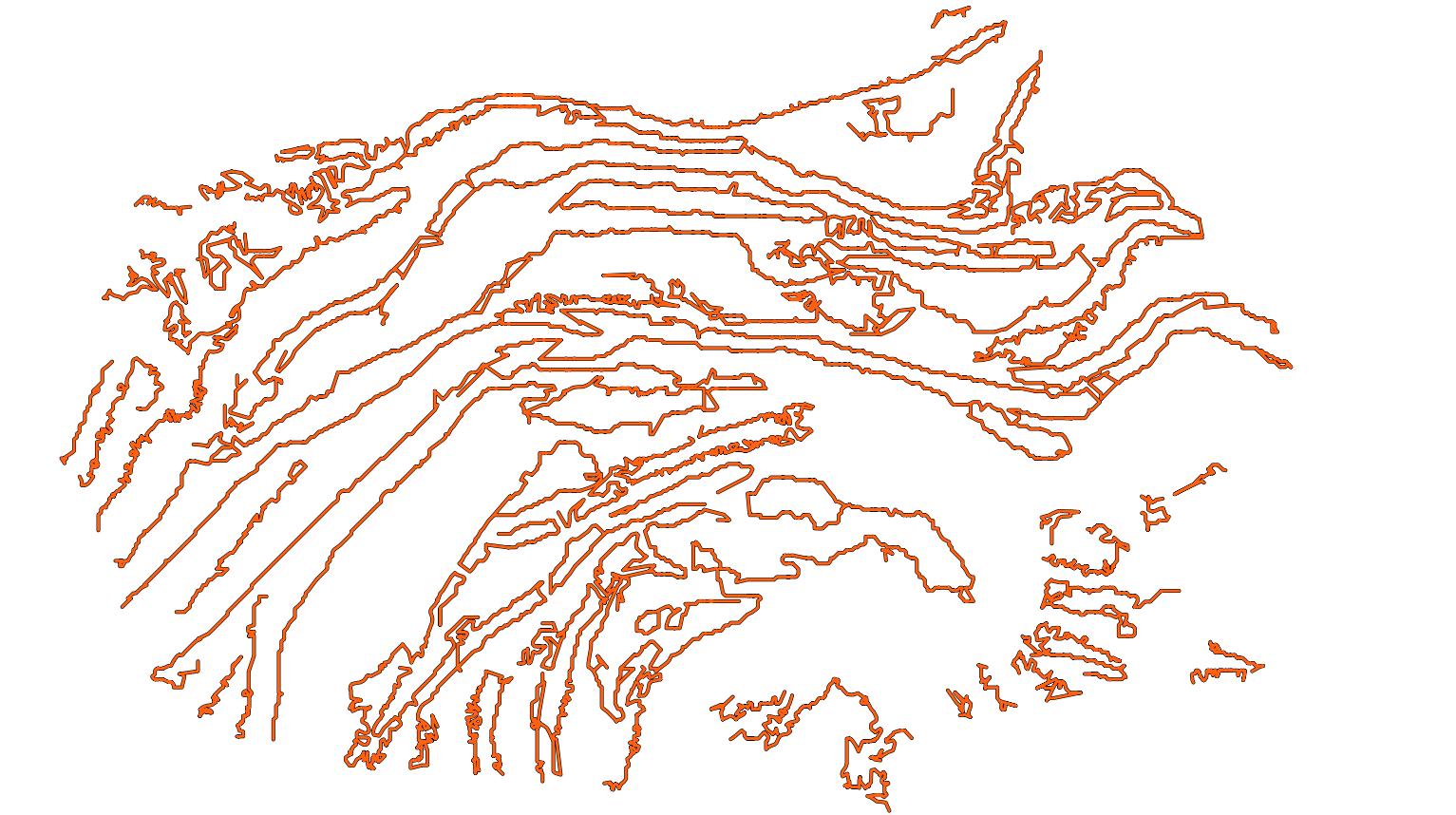
Visualization of the extracted cruves representing breaklines.
Post-processing
Once clusters are available, it might be useful to apply some post-processing
to derive useful information from them. That is what post-processing
components aim to do. They can be defined in the "post_clustering" list.
The execution will start by the first component in the list and will end
at the last one, i.e., it is sequential with respect to the order in the list.
ClusterEnveloper
The ClusterEnveloper can be used to find the geometry enclosing the
points. Envelopes often support the estimation of the enclosed volume. They can
be exported to output files. The JSON below shows how to define a cluster
enveloper post-processor inside the post-processing pipeline of a clusterer.
"post_clustering": [
    {
        "post-processor": "ClusterEnveloper",
        "envelopes": [
            {
                "type": "AlignedBoundingBox",
                "compute_volume": true,
                "output_path": "*/aabbs.csv",
                "separator": ","
            },
            {
                "type": "BoundingBox",
                "compute_volume": true,
                "output_path": "*/bboxes.csv",
                "separator": ","
            }
        ]
    }
]
The JSON above defines a ClusterEnveloper that will compute the
axis-aligned bounding box and also the oriented bounding box. The volume will
be computed for each envelope and they will be exported to a CSV file.
More concretely, each row in the CSV will contain three coordinates
representing a vertex, an integer representing the cluster label, and the
estimated volume. All the values will be separated by ,.
Arguments
- –
envelopes List of envelopes that must be computed by the
ClusterEnveloper–
typeThe type of the envelope, it can be
"AxisAlignedBoundingBox"or"BoundingBox"(the edges of the last one are not necessarily parallel to the vectors of the canonical basis).–
compute_volumeFlag to specify whether to compute the volume enclosed by the envelope (
true) or not (false).–
output_pathThe path where the envelope’s data will be exported (typically in CSV format).
–
separatorThe separator to be used in the output CSV file.
ClusterMarker
The ClusterMarker can be used to compute a point for each cluster
to represent it. These points can be exported as CSV files or shapefiles.
The JSON below shows how to define a cluster marker post-processor inside the
post-processing pipeline of a clusterer.
"post_clustering": [
    {
        "post-processor": "ClusterMarker",
        "strategy": "centroid",
        "proj_str": null,
        "epsg": 32630,
        "output_path": "*/marks.shp",
        "nthreads": -1
    }
]
The JSON above defines a ClusterMarker that will compute the centroid
for each cluster as a marker. The output will be exported in the EPSG:32630
CRS to a shapefile called marks.shp. The computations will be carried out
using all the cores available in the system.
Arguments
- –
strategy The strategy that must be used to compute the markers. Supported strategies are
"centroid", (seeClusterMarker.compute_cluster_centroid()),"midrange"(seeClusterMarker.compute_cluster_midrange()),"medianoid"(seeClusterMarker.compute_cluster_medianoid()),"medoid"(seeClusterMarker.compute_cluster_medoid()), and"geometric_median"(seeClusterMarker.compute_cluster_geometric_median()).- –
proj_str The coordinate reference system specified as a projection string (proj).
- –
epsg Can be optionally used to specified the CRS following the European Petroleum Survey Groups (EPSG) standard format.
- –
nthreads The number of threads that must be used for the parallel computations. Note that -1 means using as many threads as available cores.
- –
output_path The output path where the markers must be written. Note that if the extension is
.shp, then the output will be written as a shapefile. Otherwise, it will be written as an ASCII CSV file.
ClusterSelector
The ClusterSelector can be used to discard those clusters that do not
satisfy satisfy some given criteria. It consists of a list of filters that
check some given relationals and either preserve or discard those clusters
that satisfy them. The JSON below shows how to define a cluster enveloper
post-processor inside the post-processing pipeline of a clusterer.
"post_clustering": [
    {
        "post-processor": "ClusterSelector",
        "filters": [
          {
            "attribute": "number_of_points",
            "relational": "greater_than_or_equal_to",
            "target": 256,
            "action": "preserve"
          },
          {
            "attribute": "surface_area",
            "relational": "less_than",
            "target": 1,
            "action": "discard"
          },
          {
            "attribute": "z_length",
            "relational": "less_than",
            "target": 3,
            "action": "discard"
          }
        ]
    }
]
The JSON above defines a ClusterSelector that will preserve only
the clusters with at least \(256\) points and discard those whose convex
hull has a surface area less than \(1\) meter or whose length along
the \(z\)-axis is below the \(3\) meters.
Arguments
- –
filters The list of filters based on relational conditions to decide whether to preserve or discard those clusters who satisfy them.
- –
attribute The attribute involved in the relational condition as the left-hand side. Supported attributes are
"number_of_points","surface_area","volume","surface_density","volume_density","x_length","y_length"and"z_length". Their description can be read in the documentation ofClusterSelector.- –
relational The relational governing the condition. Supported relationals are
"not_equals"\(x \neq y\),"equals"\(x = y\),"less_than"\(x < y\),"less_than_or_equal_to"\(x \leq y\),"greater_than"\(x > y\),"greater_than_or_equal_to"\(x \geq y\),"in"\(x \in S\),"not_in"\(x \notin S\), and"inside"\(x \in [a, b] \subset \mathbb{R}\).- –
target The right-hand side of the relational condition.
- –
action Whether to
"preserve"or"discard"the clusters that satisfy the relational condition.
- –
Decorators
Furthest point sampling decorator
The FPSDecoratorTransformer can be used to decorate a data clusterer
such that the computations can take place in a transformed space of reduced
dimensionality. Typically, the domain of a clustering is the entire point
cloud, let us say \(m\) points. When using a FPSDecoratedClusterer
this domain will be transformed to a subset of the original point cloud with
\(R\) points, such that \(m \geq R\). Decorating a clusterer with this
decorator can be useful to reduce its execution time.
{
    "clustering": "fpsdecorated",
    "fps_decorator": {
        "num_points": "m/10",
        "fast": true,
        "num_encoding_neighbors": 1,
        "num_decoding_neighbors": 1,
        "release_encoding_neighborhoods": false,
        "threads": 16,
        "representation_report_path": null
    },
    "decorated_clusterer": {
        "clustering": "dbscan",
        "cluster_name": "cluster_wood",
        "precluster_name": "prediction",
        "precluster_domain": [1],
        "min_points": 200,
        "radius": 3.0,
        "post_clustering": [
            {
                "post-processor": "ClusterEnveloper",
                "envelopes": [
                    {
                        "type": "AlignedBoundingBox",
                        "compute_volume": true,
                        "output_path": "*/aabbs.csv",
                        "separator": ","
                    },
                    {
                        "type": "BoundingBox",
                        "compute_volume": true,
                        "output_path": "*/bboxes.csv",
                        "separator": ","
                    }
                ]
            }
        ]
    }
}
Arguments
- –
fps_decorator The specification of the furthest point sampling (FPS) decoration carried out through the
FPSDecoratorTransformer.- –
num_points The target number of points \(R\) for the transformed point cloud. It can be an integer or an expression that will be evaluated with \(m\) representing the number of points of the original point cloud, e.g.,
"m/2"will downscale the point cloud to half the number of points.- –
fast Whether to use exact furthest point sampling (
false) or a faster stochastic approximation (true).- –
num_encoding_neighbors How many closest neighbors in the original point cloud are considered for each point in the transformed point cloud to reduce from the original space to the transformed one.
- –
num_decoding_neighbors How many closest neighbors in the transformed point cloud are considered for each point in the original point cloud to propagate back from the transformed space to the original one.
- –
release_encoding_neighborhoods Whether the encoding neighborhoods can be released after computing the transformation (
true) or not (false). Releasing these neighborhoods means theFPSDecoratorTransformer.reduce()method must not be called, otherwise errors will arise. Setting this flag to true can help saving memory when needed.- –
threads The number of parallel threads to consider for the parallel computations. Note that
-1means using as many threads as available cores.- –
representation_report_path Where to export the transformed point cloud. In general, it should be
nullto prevent unnecessary operations. However, it can be enabled (by given any valid path to write a point cloud file) to visualize the points that are seen by the data miner.
- –
- –
decorated_clusterer A typical clustering specification. See the DBScan clusterer for an example.
Minimum distance decimator decorator
The MinDistDecimatorDecorator can be used to decorate a clusterer such
that the computations can take place in a transformed space of reduced
dimensionality. Typically, the domain of a clusterer is the entire point cloud,
let us say \(m\) points. When using a MinDistDecoratedClusterer
this domain will be transformed to a subset of the original point cloud with
\(R \leq m\) points. This representation is achieved by assuring that no
point is closer to its closest neighbor than a given minimum distance
threshold. Decorating a clusterer with this decorator can be useful to reduce
its execution time.
{
    "clustering": "MinDistDecorated",
    "mindist_decorator": {
        "min_distance": 0.3,
        "num_encoding_neighbors": 1,
        "num_decoding_neighbors": 1,
        "release_encoding_neighborhoods": false,
        "threads": -1,
        "representation_report_path": null
    },
    "decorated_clusterer": {
        "clustering": "dbscan",
        "cluster_name": "bunny",
        "precluster_name": "classification",
        "min_points": 3,
        "radius": 3.0
    }
}
Arguments
- –
mindist_decorator See the minimum distance decorated miner documentation about arguments .
- –
decorated_clusterer A typical clustering specification. See the DBScan clusterer for an example.