Transformers
Transformers are components that apply a transformation on the point cloud.
They can be divided into class transformers (ClassTransformer) that
transform the classification and predictions of the point cloud, feature
transformers (FeatureTransformer) that transform the features of
the point cloud, and point transformers (PointTransformers) that
compute an advanced transformation on the point cloud that involves different
information (e.g., spatial coordinates to derive
receptive fields that can be used to reduce or propagate both features and
classes).
Transformers are typically use inside pipelines to apply transformations to the point cloud at the current pipeline’s state. Readers are strongly encouraged to read the Pipelines documentation before looking further into transformers.
Class transformers
Class reducer
The ClassReducer takes an original set of \(n_I\) input classes
and returns \(n_O\) output classes, where \(n_O < n_I\). It can be
applied to the reference classification only or also to the predictions.
On top of that, it supports a text report on the distributions with the
absolute and relative frequencies and a plot of the class distribution before
and after the transformation. A ClassReducer can be defined inside a
pipeline using the JSON below:
{
        "class_transformer": "ClassReducer",
        "on_predictions": false,
        "input_class_names": ["noclass", "ground", "vegetation", "cars", "trucks", "powerlines", "fences", "poles", "buildings"],
        "output_class_names": ["noclass", "ground", "vegetation", "buildings", "objects"],
        "class_groups": [["noclass"], ["ground"], ["vegetation"], ["buildings"], ["cars", "trucks", "powerlines", "fences", "poles"]],
        "report_path": "class_reduction.log",
        "plot_path": "class_reduction.svg"
}
The JSON above defines a ClassReducer that will replace the nine
original classes into five reduced classes where many classes are grouped
together as the "objects" class. Moreover, it will generate a text report
in a file called class_reduction.log and a figure representing the class
distribution in class_reduction.svg.
Arguments
- –
on_predictions Whether to also reduce the predictions if any (True) or not (False). Note that setting
on_predictionsto True will only work if there are available predictions.- –
input_class_names A list with the names of the input classes.
- –
output_class_names A list with the desired names for the output classes.
- –
class_groups A list of lists such that the list i defines which classes will be considered to obtain the reduced class i. In other words, each sublist contains the strings representing the names of the input classes that must be mapped to the output class.
- –
report_path Path where the text report on the class distributions must be written. If it is not given, then no report will be generated.
- –
plot_path Path where the plot of the class distributions must be written. If it is not given, then no plot will be generated.
Output
The examples in this section come from applying a ClassReducer to the
5080_54435.laz point cloud of the
DALES dataset
.
An example of the plot representing how the classes are distributed
before and after the ClassReducer is shown below.
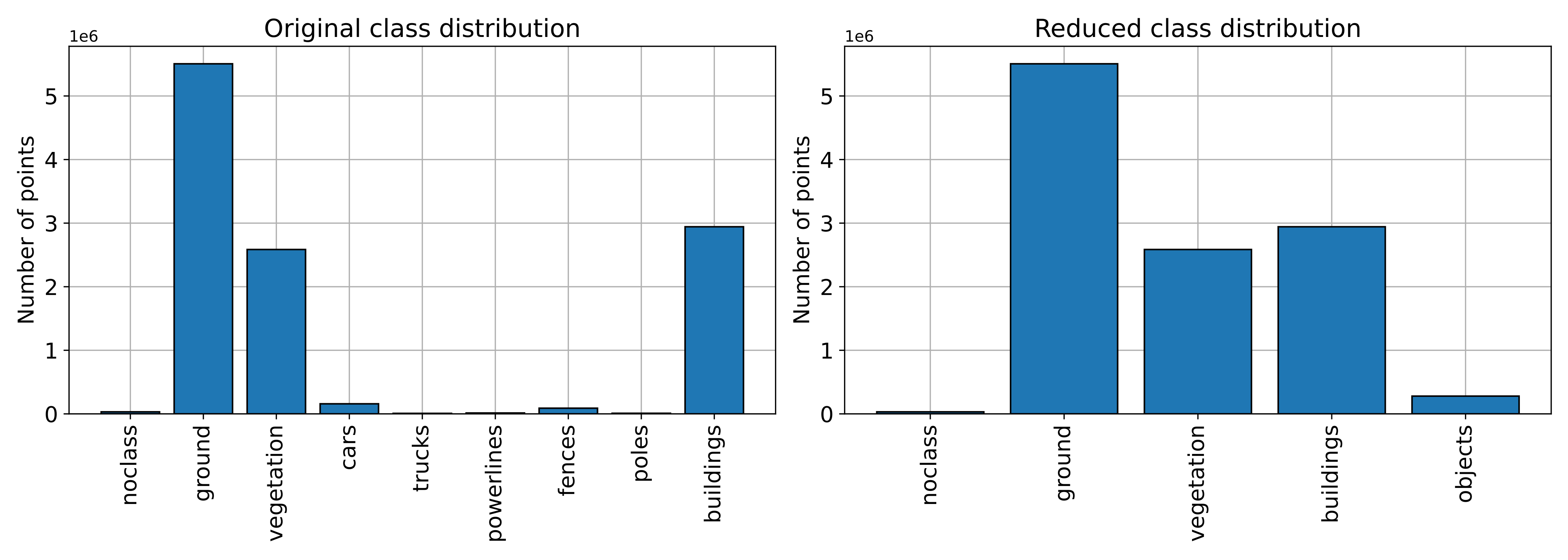
Visualization of the class distributions before and after the class reduction.
An example of how the classes represented on the point cloud look like before
and after the ClassReducer is shown below.
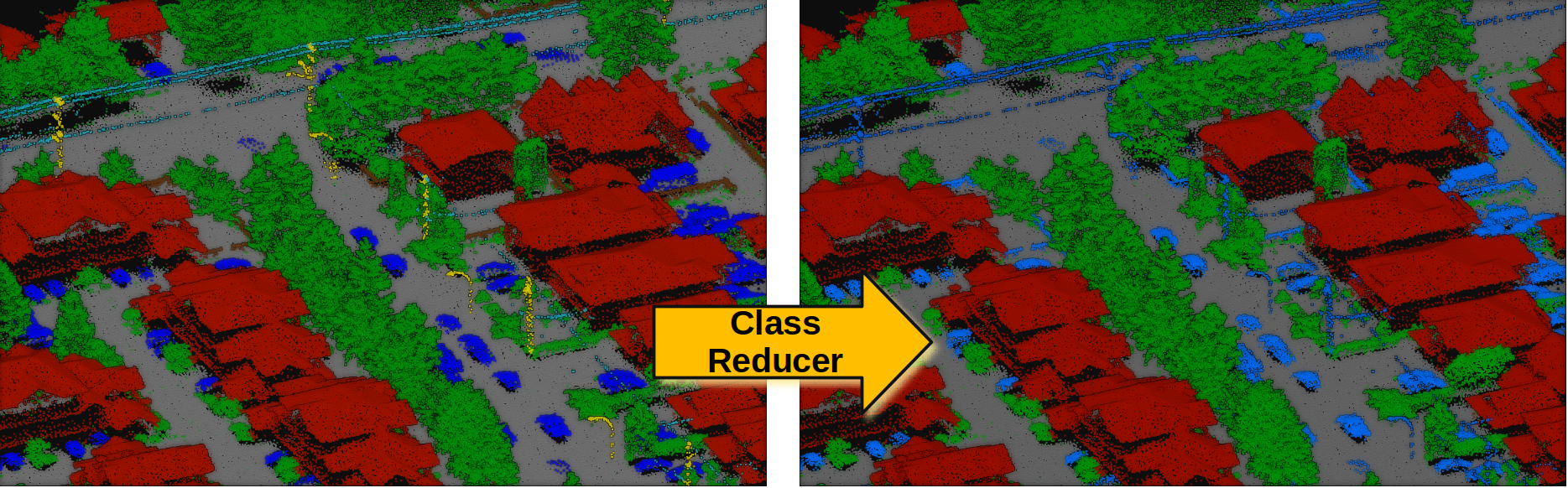
Visualization of the original (left) and reduced classification (right).
Class setter
The ClassSetter assigns the classes of a point cloud from any of
its attributes. A ClassSetter can be defined inside a pipeline using
the JSON below:
{
    "class_transformer": "ClassSetter",
    "fname": "prediction"
}
The JSON above defines a ClassSetter that will assign the
"prediction" attribute as the point-wise classes of the point cloud.
Arguments
- –
fname The name of the attribute that must be considered as the new classification of the point cloud.
Distance reclassifier
The DistanceReclassifier takes an original set of \(n_I\) input
classes and returns \(n_O\) output classes. It can be applied to the
reference classification or to the predictions. The transformation is based
on relational filters, k-nearest neighbors neighborhoods, and point-wise
distances involving the structure and feature spaces. It also supports a text
report on the distributions with the absolute and relative frequencies and a
plot of the class distribution before and after the transformation. A
DistanceReclassifier can be defined inside a pipeline using the
JSON below:
{
    "class_transformer": "DistanceReclassifier",
    "on_predictions": false,
    "input_class_names": ["ground", "vegetation", "building", "other"],
    "output_class_names": ["ground", "lowveg", "midveg", "highveg", "building", "other"],
    "reclassifications": [
      {
        "source_classes": ["vegetation"],
        "target_class": "highveg",
        "conditions": null,
        "distance_filters": null
      },
      {
        "source_classes": ["vegetation"],
        "target_class": "lowveg",
        "conditions": [
          {
            "value_name": "floor_dist",
            "condition_type": "less_than",
            "value_target": 0.5,
            "action": "preserve"
          }
        ],
        "distance_filters": null
      },
      {
        "source_classes": ["vegetation"],
        "target_class": "lowveg",
        "conditions": null,
        "distance_filters": [
          {
            "metric": "euclidean",
            "components": ["z"],
            "knn": {
              "coordinates": ["x", "y"],
              "max_distance": null,
              "k": 1,
              "source_classes": ["ground"]
            },
            "filter_type": "less_than",
            "filter_target": 1.0,
            "action": "preserve"
          }
        ]
      },
      {
        "source_classes": ["vegetation"],
        "target_class": "midveg",
        "conditions": null,
        "distance_filters": [
          {
            "metric": "euclidean",
            "components": ["z"],
            "knn": {
              "coordinates": ["x", "y"],
              "max_distance": null,
              "k": 1,
              "source_classes": ["ground"]
            },
            "filter_type": "inside",
            "filter_target": [1.0, 5.0],
            "action": "preserve"
          }
        ]
      }
    ],
    "report_path": "reclassification.log",
    "plot_path": "reclassification.svg",
    "nthreads": -1
}
The JSON above defines a DistanceReclassifier that will preserve the
ground, building, and other classes while transforming the vegetation class
into lowveg (low vegetation), midveg (mid vegetation), and highveg (high
vegetation). In the process, it will generate a text report in a file called
reclassification.log and a figure representing the class distributions
in reclassification.svg.
Arguments
- –
on_predictions Whether to also reduce the predictions if any (True) or not (False). Note that setting
on_predictionsto True will only work if there are available predictions.- –
input_class_names A list with the names of the input classes.
- –
output_class_names A list with the desired names for the output/transformed classes.
- –
reclassifications A list of dictionaries such that each dictionary specifies a class transform operation.
- –
source_classes The names of the classes such that only points of these classes will be modified by the reclassification operation.
- –
target_class The name of the target/output class to which those points that satisfy the conditions and distance-based filters will be assigned.
- –
conditions A list of dictionaries such that each dictionary specifies a relational filter. See documentation about advanced input conditions .
- –
value_name See documentation about advanced input conditions value name .
- –
condition_type - –
value_target See documentation about advanced input conditions value target .
- –
action
- –
- –
distance_filters A list of dictionaries where each dictionary specifies a distance-based filter.
- –
metric The distance metric to be computed for \(n\) components. It can be either
"euclidean"\[\operatorname{d}(\pmb{p}, \pmb{q}) = \sqrt{\sum_{j=1}^{n}{(p_j-q_j)^2}}\]or
"manhattan"\[\operatorname{d}(\pmb{p}, \pmb{q}) = \sum_{j=1}^{n}{\left\lvert{p_j-q_j}\right\rvert} .\]- –
components A list with the names of the components defining the vectors whose distance will be computed. Supported components are
"x","y", and"z"for the corresponding coordinates from the structure space and also any feature name from the point cloud’s feature space.- –
knn The dictionary with the k-nearest neighbor neighborhood specification.
- –
coordinates The coordinates defining the points for the neighborhood computations. For example,
["x", "y", "z"]implies typical 3D neighborhoods and["x", "y"]implies typical 2D neighborhoods.- –
max_distance The max distance that any neighbor must satisfy. Points further away than this distance will be excluded from the neighborhood.
- –
k The number of \(k\)-nearest neighbors.
- –
source_classes Neighborhoods will only contain points belonging to the given source classes. If None, then all points will be considered as neighbors, no matter their class.
- –
- –
filter_type Like the advanced input condition type specification but also supports
"inside"(\(x \in [a, b] \subset \mathbb{R}\)).- –
filter_target See documentation about advanced input conditions value target .
- –
action
- –
- –
- –
report_path Path where the text report on the class distributions must be written. If it is not given, then no report will be generated.
- –
plot_path Path where the plot of the class distributions must be written. If it is not given, then no plot will be generated.
- –
nthreads The number of threads for the parallel computations. Note that using
-1means as many threads as available cores.
Output
The examples in this section come from applying a DistanceReclassifier
to the PNOA_2015_GAL-W_478-4766_ORT-CLA-COL point cloud of the
PNOA-II dataset
.
The figure below is the plot representing how the classes are distributed
before and after the DistanceReclassfier.
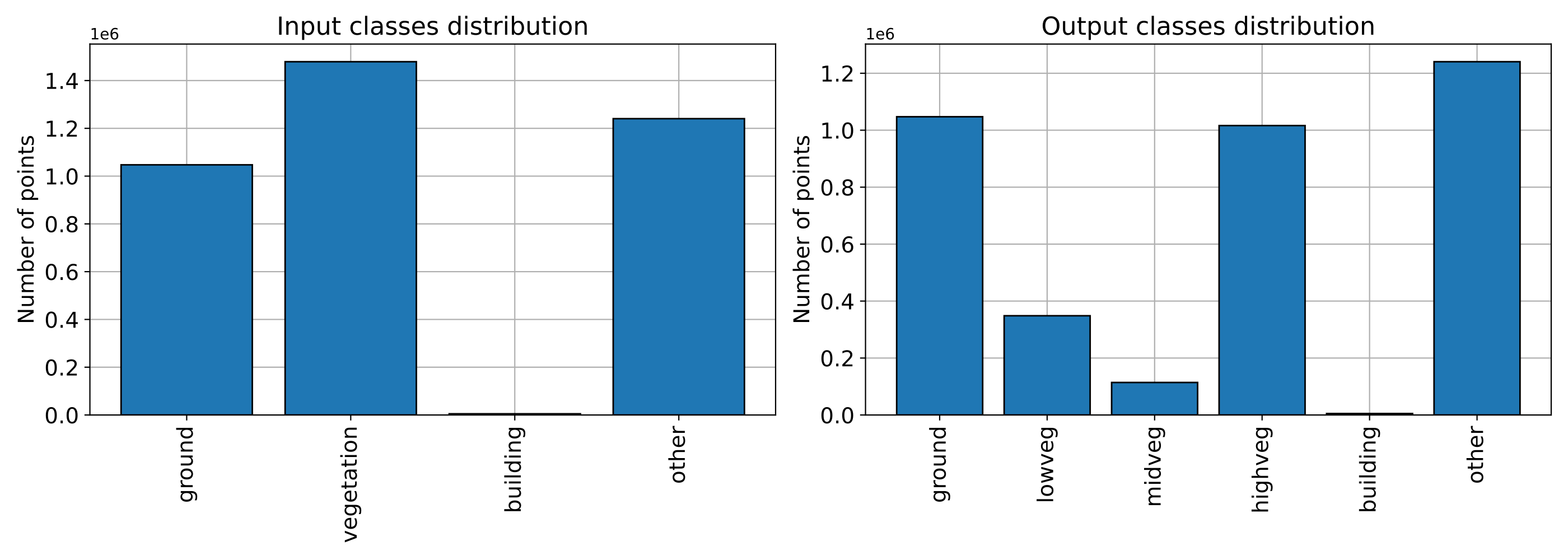
Visualization of the class distributions before and after the distance-based reclassification.
The figure below represents the vegetation reclassified by heights following the specifications from the JSON above (note that the floor distance was computed using the height features miner ++).
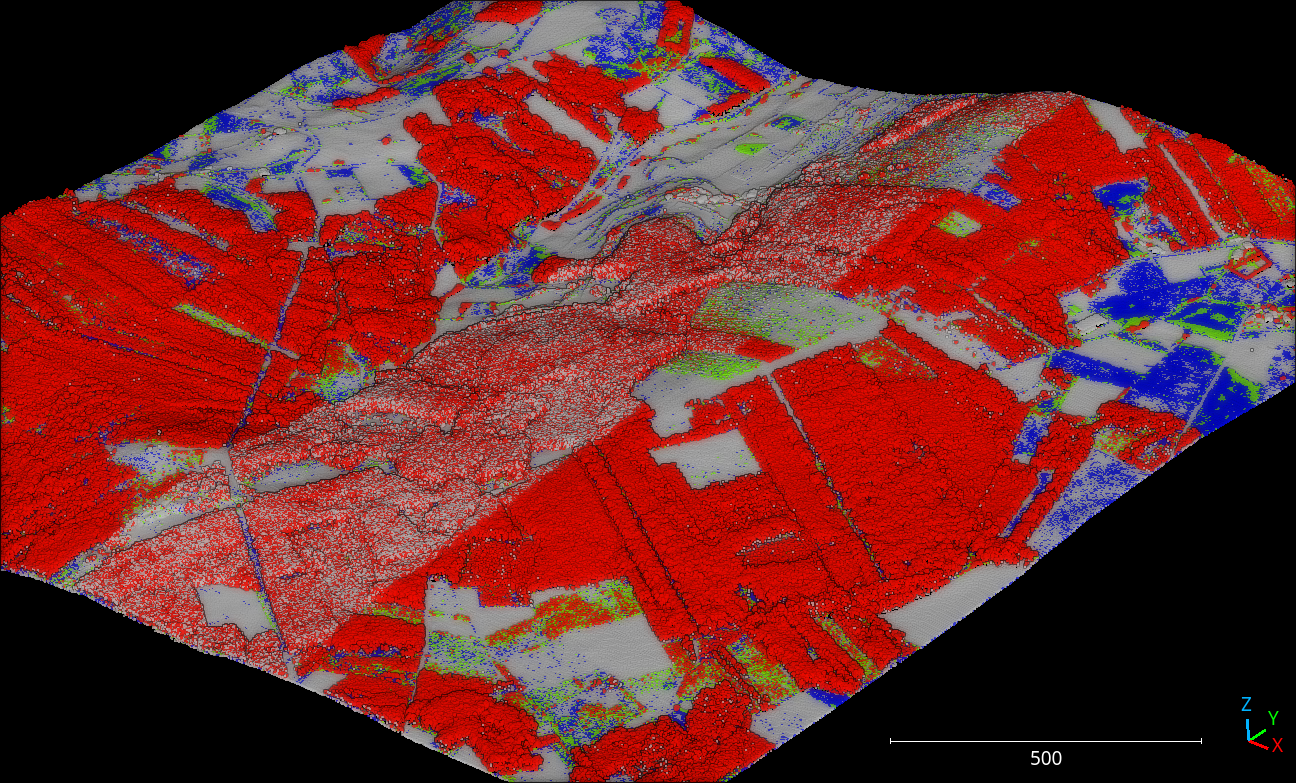
Visualization of the reclassified point cloud. Non-vegetation classes are colored white, low vegetation points are blue, mid vegetation ones are green, and high vegetation is red.
Directional reclassifier
The DirectionalReclassifier takes an original set of \(n_I\)
input classes and returns \(n_O\) output classes. It can be applied to
the reference classification or to the predictions. The transformation
relabels points in user-specified source classes as
overhang or underhang with respect to a locally fitted surface
model. Each reclassifiable seed in a covering min-distance subsample
grows a cluster via region growing, with the growth itself gated by
PCA (the cluster is accepted while the smallest eigenvalue
\(\lambda_{3}\) of its centered covariance stays at or below
\(\tau^{2}\), where \(\tau\) is eigenthreshold). The local
PCA frame \((\pmb{e}_{1}, \pmb{e}_{2}, \pmb{n})\) defines the
\((u, v, h)\) coordinates in which the surface model is represented.
For degree = 1 (default) the PCA plane itself is the surface model
and the deviation thresholded against variety_distance_tolerance is
the literal signed plane distance. For degree = 2 ... 5 a local
polynomial \(h = \pmb{\theta}^{\intercal} \pmb{\phi}(u, v)\)
(quadric, cubic, quartic, quintic) is solved by OLS (not PCA) in
that frame, and an AICc model-selection step picks per cluster between
the polynomial and its lower-degree truncations. Like
DistanceReclassifier it supports a text report with the
distributions before and after the transformation and a plot of those
distributions. A DirectionalReclassifier can be defined inside a
pipeline using the JSON below:
{
    "class_transformer": "DirectionalReclassifier",
    "on_predictions": true,
    "input_class_names": ["ground", "wall", "vegetation", "other", "break", "unlabeled"],
    "output_class_names": ["ground", "ground_obstacle", "wall", "wall_overhang", "wall_underhang", "vegetation", "other", "break", "unlabeled"],
    "reclassifications": [
        {
            "source_classes": ["wall"],
            "source_is_prediction": true,
            "forward_direction": [0, 0, 1],
            "target_overhang_class": "wall_overhang",
            "target_underhang_class": "wall_underhang",
            "conditions": [
                {
                    "value_name": "classification",
                    "condition_type": "equals",
                    "value_target": 1,
                    "action": "preserve"
                }
            ],
            "variety_distance_tolerance": 0.1,
            "eigenthreshold": 0.3,
            "init_radius": 5.0,
            "step_radius": 1.0,
            "min_distance": 0.1,
            "degree": 5,
            "trimmed_refit": true,
            "trim_factor": 1.0
        },
        {
            "source_classes": ["ground", "break"],
            "source_is_prediction": false,
            "forward_direction": [0, 0, 1],
            "target_overhang_class": "ground_obstacle",
            "target_underhang_class": null,
            "conditions": [
                {
                    "value_name": "classification",
                    "condition_type": "in",
                    "value_target": [0, 4],
                    "action": "preserve"
                }
            ],
            "variety_distance_tolerance": 0.1,
            "eigenthreshold": 0.033,
            "init_radius": 2.0,
            "step_radius": 1.0,
            "min_distance": 0.5,
            "degree": 2,
            "trimmed_refit": false,
            "trim_factor": 1.0
        }
    ],
    "report_path": "directional_reclassification.log",
    "plot_path": "directional_reclassification.svg",
    "nthreads": -1
}
The output feature columns (variety_distance, eigenmin,
fit_quality, reclassification_cluster,
reclassification_cluster_radius) are configured per
reclassification entry, not at the top level. Add the
corresponding *_as_feature and (optionally) *_name keys
to whichever entries should produce that column. Each enabled
column’s name must be unique across every reclassification — the
validator at instantiation rejects collisions. With multiple
reclassifications you typically pick distinct names (e.g.
"wall_variety_distance" and "ground_variety_distance") so
the LAS columns don’t collide.
The JSON above defines a DirectionalReclassifier that splits the
"wall" class into core wall plus "wall_overhang" (points pulled
forward of the local wall surface) and "wall_underhang" (points pushed
backward of the wall surface), and tags ground points that protrude above the
local ground plane as "ground_obstacle" while leaving any below-ground
points unchanged (target_underhang_class is null). It will also
generate a text report at directional_reclassification.log and a plot of
the class distributions at directional_reclassification.svg.
The first reclassification entry uses "min_distance": 0.0 (the default)
so the wall split runs directly on the input cloud. The second entry
demonstrates the optional decimation path: "min_distance": 0.5 first
subsamples the input via MinDistanceSubsampler at a 0.5 m radius,
runs the region-growing PCA on that decimated representation only, and
then propagates labels (and signed variety-distances when
variety_distance_as_feature is true) to non-decimated source-class
points by inheriting from each one’s closest decimated neighbor. This is
useful for very dense clouds where running the algorithm on every point is
wasteful.
The reclassification logic. Let
\(P \subset \mathbb{R}^{3}\) be the set of points selected by the
conditions filter (the geometric-computation set; defaults to the
full cloud when no conditions are given) and let
\(C \subset \mathbb{R}^{3}\) be the points whose class belongs to
source_classes (the reclassifiable set). The algorithm picks
covering seeds via min-distance subsampling on
\(C \cap P\) at min_distance = init_radius and processes them in
parallel. For each seed \(\pmb{q}\) it builds an initial neighborhood
\(N(\pmb{q}) = \left\{\pmb{p} \in P : \lVert\pmb{p} - \pmb{q}\rVert
\leq r_0\right\}\), which is always accepted, and then iteratively
expands the cluster to
\(\widetilde{N}(\pmb{q}) = N(\pmb{q}) \cup \left\{\pmb{p} \in P :
\lVert\pmb{p} - \widetilde{\pmb{p}}\rVert \leq r_{\Delta},
\widetilde{\pmb{p}} \in \widetilde{P}\right\}\) where
\(\widetilde{P}\) is the current frontier (newly-added cluster
points belonging to \(C\)). The expansion is accepted only when
\(\lambda_3(\widetilde{N}) \leq \tau^{2}\), where
\(\lambda_3\) is the smallest eigenvalue of the centered covariance
matrix of the cluster. Note that this gate is purely a cluster-shape
constraint: it bounds how far a cluster may grow before the local
covariance is no longer well-approximated as planar. For degree = 1
this gate doubles as the surface-model fit-quality threshold (since
the PCA plane is the model); for degree 2..``5`` the
polynomial fit is independent of \(\lambda_3\) and is solved by
OLS only after the cluster has stopped growing. Its quality is
assessed separately, by the AICc model-selection step (see the
degree argument below). Reclassification at degree = 1 uses
the centroid \(\pmb{\mu}\) and the smallest-eigenvalue eigenvector
\(\pmb{n}\) of the last accepted state, sign-aligned with the
user-supplied forward direction \(\pmb{u}\) (so
\(\pmb{u}^{\intercal} \pmb{n} > 0\)):
For degree 2..``5`` the same threshold semantics
\(|d| \geq \epsilon \;\Rightarrow\; \text{label}\) apply, but
\(d\) is replaced by a safeguarded geometric-distance estimate
to the locally-fit polynomial surface (option-1 tangent-plane distance
plus a one-step Newton refinement, with magnitude clamping); see the
degree argument below for the full derivation.
When several regions claim the same point (overlap between covering
seeds), the case with the largest neighborhood radius
\(R(\pmb{q}) = \max_{\pmb{x} \in N(\pmb{q})}
\lVert \pmb{x} - \pmb{\mu} \rVert\) wins. On equal radii, the seed with
the smallest seed-id wins (deterministic across thread counts). Points
in \(C\) that are not in \(P\) (e.g., source-class points
filtered out by conditions) cannot seed regions and never appear in
any neighborhood, so they are silently left unchanged.
Arguments
- –
on_predictions Whether to also reclassify the predictions if any (True) or not (False). Note that setting
on_predictionsto True will only work if predictions are available.- –
input_class_names A list with the names of the input classes.
- –
output_class_names A list with the desired names for the output/transformed classes.
- –
reclassifications A list of dictionaries such that each dictionary specifies a directional reclassification operation.
- –
source_classes The names of the classes such that only points of these classes will be modified by the reclassification operation. Note that, by default, all points are considered for the geometric computations; only those corresponding to
source_classeswill be modified. To consider in the computations only thesource_classes, they must also be specified inconditions.- –
source_is_prediction Whether the
source_classesmust be taken from the"classification"attribute (False, the default) or from the"prediction"attribute (True).- –
forward_direction A three-component vector representing the forward direction. It is used to break the sign ambiguity of the estimated normal for the fitted plane. Internally normalized to unit length. Vectors with Euclidean norm below \(10^{-7}\) are rejected with an informative error.
- –
target_overhang_class The name of the output class to assign to overhang points. When
null, no overhang reclassification is performed.- –
target_underhang_class The name of the output class to assign to underhang points. When
null, no underhang reclassification is performed.- –
conditions A list of dictionaries such that each dictionary specifies a relational filter. See documentation about advanced input conditions . When
nullor missing, the geometric-computation set \(P\) is the full cloud.- –
value_name See documentation about advanced input conditions value name . Additionally accepts
"classification"and"prediction"to filter on the corresponding point-wise channel.- –
condition_type - –
value_target See documentation about advanced input conditions value target .
- –
action
- –
- –
variety_distance_tolerance The variety-distance tolerance \(\epsilon \geq 0\). Points whose signed projection on the local plane normal is at least \(+\epsilon\) are labeled as overhang; points with projection at most \(-\epsilon\) are labeled as underhang. Otherwise the class is left unchanged.
- –
eigenthreshold The eigenvalue threshold \(\tau \geq 0\). A region-growing iteration is accepted when \(\lambda_3(\widetilde{N}) \leq \tau^{2}\), where \(\lambda_3\) is the smallest eigenvalue of the centered covariance of the trial cluster. The initial cluster (the one computed with
init_radius) is always accepted regardless of \(\lambda_3\).This gate is applied identically for every value of
degree: it is a constraint on the cluster’s geometric shape (how close to planar the cluster’s PCA covariance is), not a constraint on the polynomial fit’s residuals. Fordegree = 1it doubles as the surface-model fit-quality threshold (since the PCA plane is the model). Fordegree2..``5`` the polynomial fit happens after cluster growth has finished, on the cluster the gate produced; its goodness-of-fit is measured by AICc on the residual sums of squares, not by \(\lambda_3\). Loweringeigenthresholdtherefore tightens cluster shape (smaller, more strictly planar regions) regardless of the polynomial order, it does not, by itself, force a tighter polynomial fit on a curved cluster.- –
init_radius The initial sphere radius \(r_0 > 0\) for the seed query. Also used as the minimum distance for the covering subsampling of seeds, so every reclassifiable point is within \(r_0\) of at least one seed.
- –
step_radius The expansion radius \(r_{\Delta} > 0\) for each region-growing iteration around the current frontier.
- –
min_distance Optional min-distance decimation radius \(d_{*} \geq 0\). When
> 0, the input cloud is first subsampled viaMinDistanceSubsamplerat this radius, the region-growing PCA runs on the decimated representation, and every point in the reclassification domain (i.e., source-class point) that was NOT kept by the decimation inherits its label (and signed variety-distance, whenvariety_distance_as_featureistrue) from its closest decimated neighbor. When0(the default),null, or missing, no decimation is applied and the algorithm runs directly on the input cloud. The iter-1..iter-5 behavior is preserved bit-for-bit.- –
degree Order of the local surface model fit to each cluster. Defaults to
1. Supported values are1,2,3,4, and5; any other value is rejected at instantiation time with a clear exception (the substring"degree less than 1 does not make sense"for< 1and"degree > 5 is not currently supported"for> 5).With
degree = 1(the default) the cluster’s PCA plane is the surface model and the deviation thresholded againstvariety_distance_toleranceis the literal signed plane distance \(d = (\pmb{x} - \pmb{\mu})^{\intercal} \pmb{n}\), bit-for-bit identical to the iter-1..iter-N contract.With
degree = 2a least-squares quadric\[h(u, v) = \theta_0 + \theta_1 u + \theta_2 v + \theta_3 u^{2} + \theta_4 u v + \theta_5 v^{2}\]is fit in the local PCA frame \((\pmb{e}_{1}, \pmb{e}_{2}, \pmb{n})\) and the thresholded deviation is a safeguarded geometric-distance estimate from the query point \(\pmb{p}_{Q}\) (the cluster point currently being labeled) to the locally-fit quadric surface. The query point’s coordinates in the local PCA frame are obtained by shifting against the cluster centroid \(\pmb{\mu}\) and projecting on the local axes:
\[u_{P} = (\pmb{p}_{Q} - \pmb{\mu})^{\intercal} \pmb{e}_{1}, \quad v_{P} = (\pmb{p}_{Q} - \pmb{\mu})^{\intercal} \pmb{e}_{2}, \quad h_{P} = (\pmb{p}_{Q} - \pmb{\mu})^{\intercal} \pmb{n}.\](Distinct from the geometric-computation set \(P\) defined in the algorithm overview above; the bold-vector \(\pmb{p}_{Q}\) here is a single point being labeled, not a set.) The geometric-distance estimate removes intrinsic curvature from the deviation, so true protrusions stand out on curved walls instead of being drowned in curvature-induced sagitta. The threshold semantics \(|d| \geq \epsilon \;\Rightarrow\; \text{label}\) are unchanged across both modes. Only the geometric meaning of the deviation changes.
The safeguarded geometric distance for
degree = 2combines two cheap closed-form estimates and clamps to the smaller magnitude. With first partials at the vertical foot\[\begin{split}h_{u}^{(0)} &= \theta_{1} + 2 \theta_{3} u_{P} + \theta_{4} v_{P}, \\ h_{v}^{(0)} &= \theta_{2} + \theta_{4} u_{P} + 2 \theta_{5} v_{P},\end{split}\]and vertical residual \(r_{0} = h_{P} - h(u_{P}, v_{P})\), the first-order tangent-plane distance is
\[d_{1} = \frac{r_{0}}{\lVert \pmb{N}_{0} \rVert}, \quad \lVert \pmb{N}_{0} \rVert = \sqrt{ 1 + (h_{u}^{(0)})^{2} + (h_{v}^{(0)})^{2} }.\]The one-step Newton refinement minimises the squared 3D distance \(f(u, v) = \tfrac{1}{2} \lVert \pmb{p}_{Q} - \pmb{S}(u, v) \rVert^{2}\) with \(\pmb{S}(u, v) = (u, v, h(u, v))\). Centred terms vanish at the initial guess \((u_{P}, v_{P})\), so the gradient simplifies to \(\nabla f \big|_{0} = - r_{0} \, (h_{u}^{(0)}, h_{v}^{(0)})^{\intercal}\) and the Hessian is
\[\begin{split}\pmb{H}_{0} = \begin{pmatrix} 1 + (h_{u}^{(0)})^{2} - 2 \theta_{3} r_{0} & h_{u}^{(0)} h_{v}^{(0)} - \theta_{4} r_{0} \\ h_{u}^{(0)} h_{v}^{(0)} - \theta_{4} r_{0} & 1 + (h_{v}^{(0)})^{2} - 2 \theta_{5} r_{0} \end{pmatrix}.\end{split}\]The Newton step \(\pmb{\Delta} = -\pmb{H}_{0}^{-1} \nabla f \big|_{0} = r_{0} \, \pmb{H}_{0}^{-1} (h_{u}^{(0)}, h_{v}^{(0)})^{\intercal}\) is solved by Cramer’s rule. Writing \(H_{0,11}, H_{0,22}, H_{0,12}\) for the Hessian entries:
\[\begin{split}\Delta_{u} &= \frac{ r_{0} \, (H_{0,22} h_{u}^{(0)} - H_{0,12} h_{v}^{(0)}) }{\det \pmb{H}_{0}}, \\ \Delta_{v} &= \frac{ r_{0} \, (H_{0,11} h_{v}^{(0)} - H_{0,12} h_{u}^{(0)}) }{\det \pmb{H}_{0}}.\end{split}\]With refined foot \((u^{*}, v^{*}) = (u_{P} + \Delta_{u}, v_{P} + \Delta_{v})\) and refined residual \(r^{*} = h_{P} - h(u^{*}, v^{*})\), the geometric- distance estimate is
\[d_{2} = \mathrm{sign}(r^{*}) \, \sqrt{ \Delta_{u}^{2} + \Delta_{v}^{2} + (r^{*})^{2} }.\]The safeguard picks whichever has smaller magnitude
\[\begin{split}d_{\text{out}} = \begin{cases} d_{2} & \text{if } |d_{2}| < |d_{1}|, \\ d_{1} & \text{otherwise.} \end{cases}\end{split}\]Singular Hessian (\(|\det \pmb{H}_{0}|\) below the
solve2x2tolerance) and non-finite Newton steps fall back to \(d_{1}\) directly.By construction \(|d_{\text{out}}| \leq |d_{1}|\), so the safeguard clamps the magnitude and Newton failures never produce a result larger than the first-order estimate. This is a magnitude-clamping safeguard, not a strict accuracy guarantee with respect to the true geometric distance: on pathological configurations a query point sitting on the convex side of a strongly curved quadric, with vertical residual comparable to the local radius of curvature, or an indefinite-Hessian (saddle) quadric where the surface curves away from the tangent plane along one principal direction \(d_{1}\) may already underestimate the true geometric distance, and the correctly-larger \(|d_{2}|\) is then discarded. These regimes are rare in the region-grown clusters of moderate size that arise from typical wall-detection workloads.
Inside
degree = 2each cluster also runs an AIC model selection that letsdegree = 2automatically fall back to the plane fit when the quadric isn’t justified by the data. Define\[\mathrm{RSS}_{1} = \sum_{i=1}^{m} h_{i}^{2}, \quad \mathrm{RSS}_{2} = \sum_{i=1}^{m} \bigl( h_{i} - h_{\text{pred}}(u_{i}, v_{i}) \bigr)^{2}.\]\(\mathrm{RSS}_{2}\) is computed cheaply via the OLS identity \(\mathrm{RSS}_{2} = \mathrm{RSS}_{1} - \pmb{\theta}^{\intercal} \pmb{b}\) (no second cluster pass). With MLE-style variance estimators \(\hat{\sigma}_{k}^{\,2} = \mathrm{RSS}_{k} / m\) and Akaike’s criterion \(\mathrm{AIC}_{k} = m \, \ln \hat{\sigma}_{k}^{\,2} + 2 p_{k}\) (with \(p_{1} = 3\), \(p_{2} = 6\)), the cluster picks the plane when \(\mathrm{AIC}_{1} < \mathrm{AIC}_{2}\) equivalently
\[m \, \ln \frac{\hat{\sigma}_{1}^{\,2}} {\hat{\sigma}_{2}^{\,2}} < 2 (p_{2} - p_{1}) = 6.\]Otherwise the quadric is used. For clusters where AIC picks the plane, the per-point reclassification skips the Newton+safeguard block entirely and uses the literal signed plane distance \(d = (\pmb{x} - \pmb{\mu})^{\intercal} \pmb{n}\) (byte-equivalent to
degree = 1).Small clusters with \(m \leq 12 = 2 p_{2}\) default to the plane fit unconditionally. At \(m = 6\) the quadric exactly interpolates and AIC trivially picks it on rounding noise; the \(m \leq 2 p_{2}\) guard avoids that overfitting regime.
degree = 2is therefore a capability upper bound rather than a forced model choice. AIC is a goodness-of- fit criterion, not an F1-optimal one: in rare configurations where a quadric absorbs a few bumps as “curvature” AIC may still pick the quadric and miss them, but this regime is uncommon for the region-grown clusters of moderate size that arise from standard wall-detection workloads.With
degree = 3a local cubic polynomial\[h(u, v) = \theta_{0} + \theta_{1} u + \theta_{2} v + \theta_{3} u^{2} + \theta_{4} u v + \theta_{5} v^{2} + \theta_{6} u^{3} + \theta_{7} u^{2} v + \theta_{8} u v^{2} + \theta_{9} v^{3}\]is fit (10 OLS coefficients, \(p_{3} = 10\)). The normal-equations matrix \(\pmb{A}_{3}\) is \(10 \times 10\) and is filled from 28 distinct monomial sums in a single fused pass over the cluster. The quadric submatrix \(\pmb{A}_{2}\) is the top-left \(6 \times 6\) block; \(\pmb{b}_{2}\) is the first 6 entries of \(\pmb{b}_{3}\). The OLS identity \(\mathrm{RSS}_{k} = \sum h_{i}^{2} - \pmb{\theta}_{k}^{\intercal} \pmb{b}_{k}\) extends to the cubic, so no second cluster pass is needed.
Inside
degree = 3each cluster runs a 3-way AICc (small-sample-corrected AIC) compare across plane, quadric, and cubic, with parameter counts \(p_{1} = 3\), \(p_{2} = 6\), \(p_{3} = 10\):\[\mathrm{AICc}_{k} = m \, \ln \hat{\sigma}_{k}^{\,2} + 2 p_{k} + \frac{ 2 p_{k} (p_{k} + 1) }{ m - p_{k} - 1 }.\]AICc’s small-sample correction (the third term) penalises the cubic’s \(p = 10\) parameters more strictly when the cluster is small (e.g., +22 to \(\mathrm{AICc}_{3}\) at \(m = 21\)), preventing AIC’s tendency to over-fit at \(m / p < 8\).
Tiered small-cluster gates for
degree = 3mode:\(m \leq 12 = 2 p_{2}\): use plane unconditionally.
\(12 < m \leq 20 = 2 p_{3}\): fit quadric only, 2-way AICc compare vs plane (skip cubic).
\(m > 20\): full 3-way AICc compare.
degree = 4anddegree = 5extend the same machinery to a local quartic (\(p_{4} = 15\) coefficients, monomial basis up through degree 4 in \(u, v\)) and quintic (\(p_{5} = 21\), monomials up through degree 5). Fordegree = 4clusters with \(m \leq 30 = 2 p_{4}\) delegate to thedegree = 3handler unchanged; for \(m > 30\) the cluster runs a 4-way AICc compare across plane, quadric, cubic, and quartic, then dispatches to the per-point safeguarded-geometric-distance loop matching the chosen model.degree = 5is analogous: clusters with \(m \leq 42 = 2 p_{5}\) delegate to thedegree = 4handler; for \(m > 42\) the cluster runs a 5-way AICc compare across plane, quadric, cubic, quartic, and quintic. The cubic-specific gradient and Hessian generalise to per-degree polynomial gradients and Hessians; the option-1 + Newton-step + smaller-magnitude safeguard structure is identical across all degrees.degree = 2mode keeps plain AIC for backwards compatibility (existing F1 baseline + regression-test fixtures);degree = 3,4, and5modes all use AICc.Note: in
degree >= 2modes thevariety_distancefeature column (enabled viavariety_distance_as_feature) carries the threshold- target value the literal signed plane distance for plane-chosen clusters, the safeguarded geometric-distance estimate \(d_{\text{out}}\) for clusters where AICc selected a non-plane model instead of the raw polynomial residual. This preserves the invariantvariety_distance ↔ variety_distance_toleranceacross all cases; users who specifically need the literal plane distance for a non-plane cluster can compute it post-hoc from the cluster geometry.
–
trimmed_refitDefault
false. Whentrue, enables the one-pass trimmed-OLS refit. After the initial fit at each AIC/AICc compare site, the cluster’s per-point residuals against the most expressive fitted model define a trim mask; points whose first-pass residual exceeds \(\mathrm{trim\_factor} \cdot \epsilon\) (where \(\epsilon\) isvariety_distance_tolerance) have their contributions subtracted from the running OLS sums via local stack copies; the surface is re-solved on the kept subset and the refit coefficients drive both the AIC/AICc compare and the per-point safeguarded-geometric- distance loop.The trim is committed only if every sub-fit that the no-trim path actually scored at this compare site can be recomputed on the trimmed set (rank gate
n_kept >= 2 p_k + 1for each refitted model \(13\) for the quadric, \(21\) for the cubic, \(31\) for the quartic, \(43\) for the quintic. Trimmed RSS satisfies monotonicity). Otherwise the trim is aborted and the no-trim path runs end-to-end. Fordegree = 3the trim is path-aware across three sub-cases:3A: cubic first-solve failed → refit quadric only at the cubic-fail branch’s 2-way AICc.
3B: cubic OK + quadric submatrix solve failed → refit cubic only at the 3-way AICc.
3C: both first-solves OK → refit both at the 3-way AICc.
degree = 4anddegree = 5extend the same path-aware all-or-nothing trim logic to the 4-way and 5-way AICc compare sites: the trim mask is derived from the most expressive successfully-fitted model’s residuals, every successfully-fitted sub-model is refit on the trimmed subset, and the trim commits only when all required refits succeed (rank gate, solver success, RSS monotonicity); otherwise the no-trim path runs end-to-end.The
degree = 3small-cluster path \(12 < m \leq 20\) (2-way plane-vs-quadric) is no- trim by design (the trim’s outerm > 20guard skips these clusters; the bump-bias failure mode is dominantly on larger clusters).Targets the bump-bias failure mode where strong bumps in a cluster pull the OLS surface fit toward themselves and produce wall-as-overhang false positives. The trimmed refit excludes the bumps from the fit, so the surface tracks the actual wall while the bumps’ true magnitude is recovered on the per-point distance loop.
Caveat: the trim mask is derived from the most expressive fitted model’s residuals. If that model is itself biased (e.g., a cubic underfitting a degree-5 wall), the trim mask may underestimate the bumps.
–
trim_factorDefault
1.0. Strictly positive, finite multiplier onvariety_distance_tolerancedefining the trim threshold \(\kappa = \mathrm{trim\_factor} \cdot \epsilon\) whentrimmed_refitistrue.1.0means “trim points whose first-pass residual exceeds the user’s overhang threshold” the natural choice. Larger values (e.g.,1.5) keep more borderline points; smaller values are more aggressive. Non-positive, non-finite, non-numeric, or boolean values are rejected at instantiation.Per-reclassification output feature columns. Every reclassification entry may independently enable any subset of the five output columns below and assign each a unique LAS column name. Each enabled column is added as an extra LAS extra-dim on the output cloud; all enabled column names must be unique across every reclassification (the validator at instantiation rejects collisions). The per-point spinlock used by the C++ binding is shared across all extras, so requesting several at once costs no extra synchronisation beyond the backing arrays.
- –
variety_distance_as_feature(bool, defaultfalse) When
true, the signed distance to the AICc-selected local surface model of the seed that won the per-point tie-break is exposed as an extrafloat32column for this reclassification. Untouched points (no seed touched them in this reclassification) carry0.- –
variety_distance_feature_name(str, default "variety_distance") Name of the LAS extra-dim column. Must be a non-empty string ≤ 32 bytes. Must be unique across every enabled column of every reclassification.- –
eigenmin_as_feature(bool, defaultfalse) When
true, the smallest eigenvalue \(\lambda_{3}\) of the cluster’s centered covariance matrix (a planarity measure of the cluster, not of the polynomial fit) is exposed as afloat32column. Untouched points carry0. Note that0is also a numerically valid eigenvalue for a perfectly planar cluster; disambiguate via the labels output if needed.- –
eigenmin_feature_name(str, default"eigenmin") Same validation rules as
variety_distance_feature_name.- –
fit_quality_as_feature(bool, defaultfalse) When
true, afloat32column carrying the per-point RMSE (root mean square error) of the AICc-selected polynomial model’s residuals on the cluster the point was reclassified within (fit_quality = sqrt((1/m) Σ rᵢ²), whererᵢis the residual of cluster pointiagainst the chosen surface model). Same length units asvariety_distance_toleranceso the two are directly comparable. Untouched points carry0.- –
fit_quality_name(str, default"fit_quality") Same validation rules as
variety_distance_feature_name.- –
reclassification_cluster_as_feature(bool, default false) Whentrue, anint32column carrying the densified cluster-id of the seed that won the per-point tie-break for this reclassification. Each entry’s ids form a contiguous[0, n-1]range scoped to that reclassification (no cross-entry stacking). Untouched points carry-1.- –
reclassification_cluster_name(str, default "reclassification_cluster") Same validation rules asvariety_distance_feature_name.- –
reclassification_cluster_radius_as_feature(bool, default
false) Whentrue, afloat32column carrying \(r_0 + n_{\text{accepted}} \cdot r_{\Delta}\) for the winning seed of this reclassification. Untouched points carry0.- –
reclassification_cluster_radius_name(str, default "reclassification_cluster_radius") Same validation rules asvariety_distance_feature_name.
- –
- –
report_path Path where the text report on the class distributions must be written. If it is not given, then no report will be generated.
- –
plot_path Path where the plot of the class distributions must be written. If it is not given, then no plot will be generated.
- –
nthreads The number of OpenMP threads for the parallel C++ execution.
-1means as many threads as available cores.
Output
The output is a point cloud with the same coordinates and feature space
as the input but with classifications (or predictions) updated according
to the directional reclassification rules described above. Classes not
listed as source_classes are preserved. When several seeds reclassify
the same point, the largest-neighborhood-radius rule (with smallest
seed-id as deterministic tie-break) decides the final label.
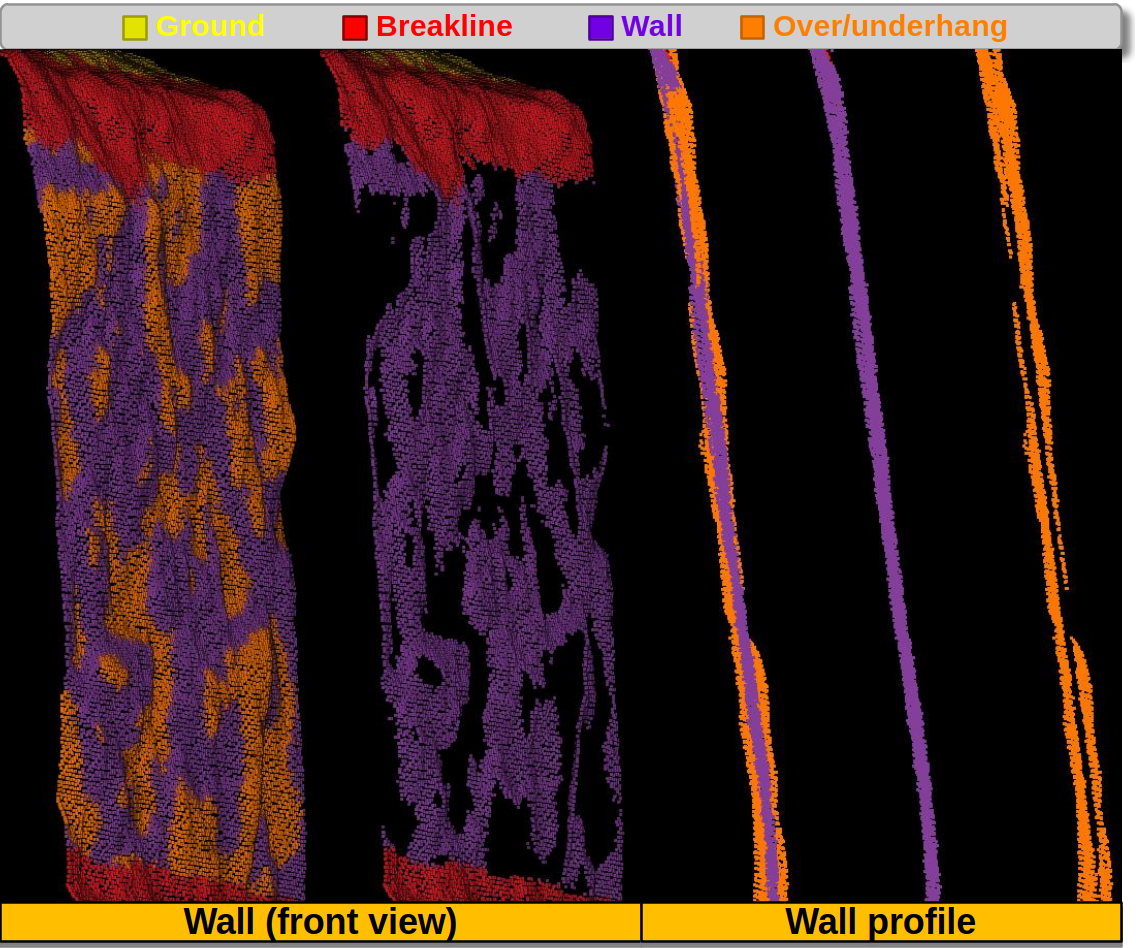
The figure below represents a wall whose overhangs and underhangs have been
reclassified as a separate class. It correponds to a JSON similar to the one
in the example of this section. However, both overhands and underhangs are
mapped to the same class here. This output example shows how the
src.utils.ctransf.directional_reclassifier.DirectionalReclassifier
can be used to get a clean representation of a surface without significant
perturbations.
Visualization of the reclassified point cloud. Wall is purple, overhangs and underhangs are orange.
Taut string reclassifier
The TautStringReclassifier reclassifies points of a
user-specified wall class as underhang when they lie deeper than a
length threshold \(D\) below a locally fitted taut string surface
envelope. The envelope is computed slice-by-slice on a per-cluster 2D
profile (the cluster’s vertical axis vs. the horizontal direction
orthogonal to its local plane normal) and bounded by a sliding vertical
window so that a single long inward curvature of the wall does not
saturate every point as an underhang. On each window the upper hull
(Andrew’s monotone chain) plays the role of the taut string: any
in-slice point whose vertical gap to the hull exceeds \(D\) is
flagged as an underhang. The depth used to threshold and emit as the
optional wall_depth feature is the max-aggregate across the
\(w / s\) overlapping windows each interior point is visited by.
Wall clusters themselves come from a region-growing pass over the
source_classes mask, seeded in deterministic input-cloud-index order
and gated by a PCA plane-tolerance criterion
(\(\lambda_3 \leq \tau^{2}\)) and a minimum-cluster-size guard.
The cluster’s centred covariance gives the plane normal \(\pmb{n}\),
which is sign-disambiguated against a horizontal direction
\(\pmb{h}\) via the cross product with the gravity axis. To tell
genuine inward concavities (underhangs) apart from outward protrusions
(overhangs), the algorithm consults a hierarchy of signals derived
from the cluster’s surrounding ground-class points: a majority side
count, a “lower-ground median” tie-break, and a “lower-ground base”
tie-break (see Mode A vs. mode B below). When ground_classes is
not provided, the algorithm runs in a non-ambiguity-resolution
fallback in which both the upper AND the lower convex hulls of each
slice are computed and the larger of the two envelope gaps is the
depth — any sufficiently deep deviation, inward or outward, is then
labeled as underhang.
A TautStringReclassifier is intended for semantically-
segmented 3D point clouds in which the wall class has already been
predicted (e.g. by a deep-learning classifier upstream in the
pipeline) and the operator wants to refine that prediction by carving
out the genuinely concave or otherwise locally-deviating regions of
each wall. The component is implemented as a thin Python wrapper over
a multi-threaded C++ backend (mirroring
DirectionalReclassifier) and exposes the same
report / output-column controls. A TautStringReclassifier
can be defined inside a pipeline using the JSON below:
{
    "class_transformer": "TautStringReclassifier",
    "on_predictions": true,
    "input_class_names": [
        "ground", "wall", "vegetation", "other", "break", "unlabeled"
    ],
    "source_classes": ["wall"],
    "underhang_class": "underhang",
    "output_class_names": [
        "ground", "wall", "underhang",
        "vegetation", "other", "break", "unlabeled"
    ],
    "depth_threshold": 0.2,
    "gravity_direction": [0, 0, 1],
    "bin_size": 0.05,
    "sliding_window_size": 5.0,
    "sliding_window_stride": 1.0,
    "plane_fit_trim": true,
    "plane_fit_trim_eps": 0,
    "initial_region_radius": 3.0,
    "region_growing_step": 1.0,
    "region_growing_plane_tolerance": 0.3,
    "ground_classes": ["ground"],
    "ground_search_radius": 0,
    "ground_min_count": 10,
    "ground_majority_ratio": 0.65,
    "ground_distance_deadband": 0,
    "ground_elevation_deadband": 0,
    "include_cluster_eigenmin": true,
    "cluster_eigenmin_name": "eigenmin",
    "include_wall_clusters": true,
    "wall_cluster_name": "wall_cluster",
    "include_depth_distance": true,
    "depth_distance_name": "wall_depth",
    "nthreads": -1,
    "report_path": null,
    "plot_path": null
}
The JSON above defines a TautStringReclassifier that operates
on the "wall" class of the predictions, relabels concave points
deeper than \(D = 0.2\) length-units as "underhang", and
exports the per-point depth distance, the per-point wall cluster id,
and the per-cluster plane-fit min eigenvalue as LAS extra dims for
downstream auditing.
Algorithm and motivating math. The transform processes each wall cluster \(C\) independently. Let \(\pmb{\mu} = \frac{1}{|C|} \sum_{i \in C} \pmb{p}_{i}\) be the cluster centroid and let \(\pmb{\Sigma}\) be its centred covariance matrix. The plane normal \(\pmb{n}\) is the unit-norm eigenvector of \(\pmb{\Sigma}\) associated with the smallest eigenvalue \(\lambda_{3}\):
When plane_fit_trim is true the PCA is refit after discarding
points whose absolute signed distance to the first-pass plane exceeds
\(\epsilon\) (auto-default \(\epsilon = D / 2\) if
plane_fit_trim_eps is 0 or null).
When the user-supplied gravity direction \(\pmb{g}\) differs from \((0, 0, 1)\), the cluster is rotated into a frame in which the gravity axis is the world-\(z\) axis. Concretely the rotation matrix \(\pmb{B} \in \mathbb{R}^{3 \times 3}\) is any orthogonal matrix with \(\pmb{B} \, \pmb{g} = (0, 0, 1)^{\intercal}\); the centred cluster is then transformed as
In the rotated frame \(\pmb{e}_{3} = (0, 0, 1)\). The horizontal direction \(\pmb{h}\) and the slicing axis \(\pmb{s}\) are derived from the cluster’s plane normal \(\pmb{n}\) by projecting out the gravity component and then taking a horizontal cross product with \(\pmb{e}_{3}\):
A hard-coded numerical gate
\(\lVert (n_{x}, n_{y}, 0) \rVert < \epsilon_{h} = 10^{-3}\)
declares the cluster as a near-horizontal “wall” (a floor / ceiling /
flat roof mislabel) and skips it with a per-cluster warning and a
dedicated near-horizontal signal in the report. \(\epsilon_h\)
is not a user hyperparameter.
For each cluster point \(\pmb{p}_{i}\) the slicing-axis distance \(\tilde{d}_{i} = \pmb{p}_{i}^{\intercal} \pmb{s}\) is binned at the user-supplied resolution \(\Delta\),
so that all cluster points within the same vertical strip of width \(\Delta\) along \(\pmb{s}\) belong to the same slice. Inside each slice the points are re-expressed in the 2D local frame
The sliding window of size \(w\) and stride \(s\) traverses the cluster’s vertical range; on each window the upper convex hull of the in-window points (mode A) or both the upper AND lower convex hulls (mode B) are computed by Andrew’s monotone chain in \(\mathcal{O}(n \log n)\). For an in-window point \((\tilde{x}_{i}, \tilde{y}_{i})\), the upper-hull line segment \((x_{a}, y_{a}) \to (x_{b}, y_{b})\) with \(x_{a} \leq \tilde{x}_{i} \leq x_{b}\) defines the linearly interpolated envelope height
In mode A (ground-based, conclusive cluster) the per-window depth distance is
In mode B (non-ambiguity-resolution or per-cluster fallback) the lower hull is interpolated analogously to obtain \(\hat{y}_{i}^{\,\text{lo}}\) and the per-window depth distance is
Each interior point is visited by \(w / s\) overlapping windows (five with the defaults \(w = 5.0\), \(s = 1.0\)); the per-point depth recorded on the output column is the max-aggregate across those visits. The thresholding rule
then drives the class column rewrite at the end of the transform.
Arguments
- –
class_transformer The factory discriminator string. Must be exactly
"TautStringReclassifier"for this transformer. Resolved at pipeline load time bysrc/utils/ctransf_utils.py::CtransfUtils.extract_ctransf_classvia case-insensitive name match against the registered class transformers.- –
on_predictions Whether to also reclassify the predictions if any (
true) or not (false). Note that settingon_predictionstotruewill only work if predictions are available on the input point cloud.- –
input_class_names A list with the names of the input classes.
- –
source_classes The names of the classes such that only points of these classes will be considered for the wall-clustering and reclassification computation. Points whose class is not in
source_classesare not removed from the output cloud — they are simply ignored by the algorithm and preserved unchanged.- –
underhang_class The name of the underhang class. Must be a member of
output_class_namesAND must not appear insource_classes(relabeling a source class as itself is a no-op and is rejected at__init__).- –
output_class_names A list with the desired names for the output/transformed classes.
- –
depth_threshold The depth \(D \in \mathbb{R}_{>0}\) at which a point’s vertical gap to the local upper convex hull is considered an underhang. Defaults to
0.2. Eager validation: must be a strictly positive finite scalar.- –
gravity_direction The unit-norm vector \(\pmb{g} \in \mathbb{R}^{3}\) pointing along the up axis (i.e. opposite the pull of gravity). Despite the name, this is the vertical axis oriented upward, not a downward acceleration vector; the naming is preserved for backwards compatibility with the framework’s other components. Defaults to
[0, 0, 1]. Eager validation: exactly 3 components, Euclidean norm \(\geq 10^{-7}\). If supplied non-unit-norm, the vector is normalised internally and an INFO log message is emitted at setup.- –
bin_size The bin width \(\Delta \in \mathbb{R}_{>0}\) of the vertical slicing along \(\pmb{s}\). Defaults to
0.05. Eager validation: \(\Delta > 0\).- –
sliding_window_size The vertical size \(w \in \mathbb{R}_{>0}\) of the sliding window in length units of the input cloud. Defaults to
5.0. Eager validation: \(w > 0\) and \(w \geq s\) (the window must be at least as large as the stride, otherwise the sliding windows leave vertical gaps). Limiting the vertical span of the convex-hull computation prevents a slight inward curvature of a full wall (say \(d = 0.5\) depth at peak with \(D = 0.2\)) from saturating every point as an underhang.- –
sliding_window_stride The vertical step \(s \in \mathbb{R}_{>0}\) of the sliding window. Defaults to
1.0. Eager validation: \(s > 0\) and \(s \leq w\). With the defaults \(w = 5.0\) and \(s = 1.0\) each interior point is visited by 5 overlapping windows; the depth recorded on the output column is the max-aggregate across those visits. Smaller strides over-sample (more robust to local hull-anchoring artefacts at window boundaries) at the cost of redundant per-point hull-distance evaluations.- –
plane_fit_trim A bool. When
truethe PCA plane is refit after discarding points that deviate more than \(\epsilon\) from the first-pass plane, yielding a more accurate plane normal for clusters whose non-surface debris perturbs the PCA fit. Defaults totrue.- –
plane_fit_trim_eps The trim threshold \(\epsilon \in \mathbb{R}_{\geq 0}\) for the optional plane refit. When given as
0ornull, the auto-default \(\epsilon = D / 2\) is used; otherwise the user-supplied value is used verbatim. Only relevant whenplane_fit_trimistrue. Defaults to0.- –
initial_region_radius The initial spherical neighborhood radius \(r_{0} \in \mathbb{R}_{>0}\) used to seed the region-growing pass. Every wall point within \(r_{0}\) of the seed forms the initial region. Defaults to
3.0. Eager validation: \(r_{0} > 0\).- –
region_growing_step The radius \(r_{\Delta} \in \mathbb{R}_{>0}\) of each successive region-growing expansion after the initial region. Defaults to
1.0. Eager validation: \(r_{\Delta} > 0\).- –
region_growing_plane_tolerance The plane-tolerance threshold \(\tau \in \mathbb{R}_{\geq 0}\) for the region-growing PCA gate. Successive expansions are accepted only when the refit min eigenvalue \(\lambda_{3} \leq \tau^{2}\). The initial region is always accepted; on rejection the cluster falls back to the last accepted state (no backtracking, no iteration skip). Defaults to
0.3. When given as0ornullthe plane-tolerance gate is disabled.- –
ground_classes Optional list of class names representing the ground in
input_class_names. Every entry must match a name ininput_class_namesexactly. Drives the algorithm’s mode:Mode A (ground-based ambiguity breaker, active when ``ground_classes`` is a non-empty list). For each wall cluster the algorithm queries the ground-class points surrounding the cluster centroid and uses them to disambiguate the sign of \(\pmb{h}\) via a three-tier signal hierarchy — primary majority side count (
majority), secondary “lower-ground median” tie-break (lower-ground-median), tertiary “lower-ground base” tie-break (lower-ground-base). Only inward concavities (underhangs) are then reclassified; outward protrusions (overhangs) are preserved. An INFO log message at the start of every transform identifies the active mode and lists the ground class names.Mode B (non-ambiguity-resolution, active when ``ground_classes`` is ``null``, missing, or empty). The sign of \(\pmb{h}\) is left as PCA returned it. Both the upper AND the lower convex hulls of each slice are computed and the max-of-two-envelopes depth rule is applied; any sufficiently large deviation (inward OR outward) is labeled as underhang. Known caveat: surface points immediately adjacent to a large overhang or underhang may receive a false underhang label because the local convex hull is anchored by the deviation, lifting (resp. lowering) the envelope across a horizontal band bounded by
sliding_window_sizeand the deviation’s projected width. The \(5\times\) sliding-window over-sampling reduces but does not eliminate the effect. Users who can supplyground_classesshould do so — mode A removes the ambiguity at the root rather than mitigating it downstream.
See the dedicated Mode A vs. mode B contract sub-section below and the Per-cluster sign-disambiguation report sub-section for the full decision rule and the report contract.
- –
ground_search_radius Radius \(R_{g} \in \mathbb{R}_{\geq 0}\) around each wall cluster centroid used to query ground points. Only applies in mode A. When given as
0ornullthe auto-default \(R_{g} = 3 \, r_{0}\) is used (three times theinitial_region_radius). When the first query returns fewer thanground_min_countpoints the radius is expanded once to \(2 R_{g}\) before declaring the cluster inconclusive. Defaults to0.- –
ground_min_count Minimum count \(N_{g}^{\min} \in \mathbb{N}_{>0}\) of ground points required (after the optional radius expansion) for mode A to fire on a cluster. When fewer than \(N_{g}^{\min}\) ground points are found, the cluster falls back to mode-B treatment for that cluster only (a per-cluster warning is emitted into the report). Only applies in mode A. Defaults to
10.- –
ground_majority_ratio Side-count fraction \(\rho_{g}^{\min} \in (0.5, 1]\) at which the primary signal of the sign disambiguation commits to an outward direction. The orientation is taken as \(\mathrm{sign}(|G_{+}| - |G_{-}|)\) provided \(\max(|G_{+}|, |G_{-}|) / (|G_{+}| + |G_{-}|) \geq \rho_{g}^{\min}\). Otherwise the algorithm falls through to the lower-ground tie-breaks. Only applies in mode A. Defaults to
0.65.- –
ground_distance_deadband Signed-distance dead-band \(\delta_{g} \in \mathbb{R}_{\geq 0}\) (length units of the input cloud) applied when classifying each ground point as lying on the \(+\pmb{n}\) side, the \(-\pmb{n}\) side, or “on the plane”. Ground points with absolute signed distance below \(\delta_{g}\) are excluded from both side counts. When given as
0ornullthe auto-default \(\delta_{g} = \Delta\) (onebin_size) is used. Only applies in mode A. Defaults to0.- –
ground_elevation_deadband Vertical dead-band \(\tau_{z} \in \mathbb{R}_{\geq 0}\) (length units of the input cloud, measured along \(\pmb{g}\)) used by the secondary and tertiary “lower-ground” tie-breaks. When the median (secondary) or base-restricted minimum (tertiary) elevations of the two sides differ by less than \(\tau_{z}\) the tie-break is declared inconclusive and the algorithm proceeds to the next signal (or to the per-cluster mode-B fallback on the last tier). When given as
0ornullthe auto-default \(\tau_{z} = r_{0}\) (oneinitial_region_radius) is used. Only applies in mode A. Defaults to0.- –
include_cluster_eigenmin A bool. When
truethe smallest eigenvalue \(\lambda_3\) of the cluster’s last-accepted centered covariance is exposed as a per-pointfloat32LAS extra-dim. Defaults tofalse.- –
cluster_eigenmin_name The LAS extra-dim name for the per-point min eigenvalue. Must be a non-empty string. Only relevant when
include_cluster_eigenministrue. Defaults to"eigenmin".- –
include_wall_clusters A bool. When
truethe per-point wall cluster id is exposed as anint32LAS extra-dim. Each accepted wall cluster is assigned a contiguous id in \([0, N - 1]\) in the seed-point-index order; non-wall points and points belonging to a skipped cluster (near-horizontalor rejected by the minimum-cluster guard) carry the sentinel value \(-1\). Defaults tofalse.- –
wall_cluster_name The LAS extra-dim name for the per-point wall cluster id. Must be a non-empty string. Only relevant when
include_wall_clustersistrue. Defaults to"wall_cluster".- –
include_depth_distance A bool. When
truethe per-point depth distance is exposed as afloat32LAS extra-dim. In mode A the depth is the signed gap below the upper envelope; in mode B (or in a per-cluster mode-A fallback) the depth is the max-of-two- envelopes gap. Wall points that were not touched by any window carry0.0. Non-wall points all carry0.0. Defaults tofalse.- –
depth_distance_name The LAS extra-dim name for the per-point depth distance. Must be a non-empty string. Only relevant when
include_depth_distanceistrue. Defaults to"wall_depth".- –
nthreads The number of OpenMP threads for the parallel C++ execution.
-1means as many threads as available cores.- –
report_path Optional filesystem path. When provided, the
TautStringReclassificationReportis persisted as a CSV at this path after each transform call. The CSV holds the per-cluster sign-disambiguation trace described in Per-cluster sign-disambiguation report below. Whennull, missing, or empty, the report is emitted only to the log through theClassTransformer.reportmachinery.- –
plot_path Accepted in the JSON for schema compatibility with the rest of the class-transformer family but not used in this iteration of the
TautStringReclassifier— unlikeDirectionalReclassifier/DirectionalReclassificationPlot, no companion plot class is generated. A future iteration may add aTautStringReclassificationPlot; until then, do not rely on plot output.
Output
The output is a point cloud with the same coordinates and feature space as the input but with classifications (or predictions) updated according to the taut-string reclassification rules described above. Non-source-class points are preserved. When several sliding windows visit the same point, the largest per-window depth wins (the max-aggregate is computed per-cluster in the C++ backend; each wall point belongs to exactly one cluster after region growing, so each output column entry has a unique writer thread and no atomics are required). The transform optionally emits up to three LAS extra-dim columns described below.
- –
<cluster_eigenmin_name>(float32, default name "eigenmin") The smallest eigenvalue \(\lambda_3\) of the wall cluster’s last-accepted centered covariance matrix. A measure of how planar the cluster is — small values mean a well-fit plane, large values mean the cluster grew across non-planar geometry. The sentinel value on points that are not in any accepted wall cluster (including non-wall points, near-horizontal-skipped cluster members, and minimum-cluster-guard rejects) is0.0. Note that0.0is also numerically valid for a perfectly planar cluster; disambiguate via the cluster id column if needed.- –
<wall_cluster_name>(int32, default name "wall_cluster") The per-point wall cluster id. Accepted wall clusters are assigned a contiguous id in \([0, N - 1]\) in the seed-point-index order. The sentinel value on points that do not participate in any accepted wall cluster is \(-1\).inconclusiveand pure mode-B clusters DO participate in cluster-id assignment (both ran through the full pipeline, just under the dual-hull treatment);near-horizontal-skipped clusters AND clusters rejected by the minimum-cluster guard DO NOT participate.- –
<depth_distance_name>(float32, default name "wall_depth") The max-aggregate per-point depth distance across all windows that visited the point. In mode A this is the canonical underhang depth \(d_{i} = \hat{y}_{i}^{\,\text{up}} - \tilde{y}_{i}\); in mode B (or in a per-cluster mode-A fallback) it is the max-of-two-envelopes depth \(d_{i} = \max(\hat{y}_{i}^{\,\text{up}} - \tilde{y}_{i}, \tilde{y}_{i} - \hat{y}_{i}^{\,\text{lo}})\). The sentinel value on points that were not visited by any window (including non-wall points and accepted-cluster wall points untouched by the sliding window) is0.0.
Mode A vs. mode B contract
The presence of the ground_classes hyperparameter selects between
two complementary code paths inside the transform, hereafter called
mode A and mode B:
Mode A is active when
ground_classesis provided as a non-empty list of class names. The algorithm queries the points of those classes around each wall cluster centroid and uses them to break the underhang-vs-overhang sign ambiguity via a three-tier signal hierarchy:Primary signal — majority side wins. The signed distance \(d_{j} = (\pmb{p}_{j} - \pmb{\mu})^{\intercal} \pmb{n}\) is computed for every ground point \(\pmb{p}_{j}\) in the candidate set; the two side counts \(|G_{+}|, |G_{-}|\) are formed after the dead-band filter \(|d_{j}| > \delta_{g}\). When the dominant side holds a fraction \(\geq \rho_{g}^{\min}\) of the qualified ground points, its sign becomes outward and the signal is recorded as
majority.Secondary signal — lower-ground median tie-break. When the side counts are too close, the median elevation of the ground points on each side (in the original gravity frame) is compared; the side whose median is lower by more than \(\tau_{z}\) is outward and the signal is recorded as
lower-ground-median.Tertiary signal — base-level lower-ground tie-break. When the medians are also within \(\tau_{z}\) of each other, ground points within \(r_{0}\) upward of the cluster base elevation are restricted; the side whose base-restricted minimum elevation is lower by more than \(\tau_{z} / 2\) is outward and the signal is recorded as
lower-ground-base.
Only inward concavities (underhangs) are reclassified in mode A. Outward protrusions (overhangs) are preserved unchanged. A per-cluster warning is emitted whenever a cluster’s signal hierarchy is exhausted without a conclusive result (signal
inconclusive); the cluster then falls back to mode-B treatment for that cluster only (see below).Mode B is active when
ground_classesisnull, missing, or an empty list. The sign of \(\pmb{h}\) is left as PCA returned it. For each slice the algorithm computes BOTH the upper AND the lower convex hulls and assigns to each point the maximum of its two depth distances; any point whose max depth exceeds \(D\) is reclassified as underhang regardless of direction. Mode B is therefore strictly less informative than mode A — it catches both inward concavities and outward protrusions — but requires no ground-class context. The known caveat is a false-positive band near large deviations (see theground_classesargument).Per-cluster mode-A inconclusive fallback. When mode A’s signal hierarchy exhausts without a conclusive result on a single cluster, that cluster falls back to the mode-B dual-hull treatment while the rest of the clusters in the same transform continue under mode A. The fallback is logged in the per-cluster report under the signal value
inconclusive.
The Arguments section above spells out the mode-A vs mode-B contract
of ground_classes and links to the per-cluster sign-
disambiguation report format documented in the next sub-section.
Per-cluster sign-disambiguation report
When report_path is provided, the transform persists a CSV file
that holds one row per wall cluster (including skipped clusters). The
CSV is generated by
TautStringReclassificationReport and written by its
to_file(path, out_prefix=None) method. The columns are, in order:
seed_point_idxThe input-cloud index of the cluster’s seed point (the smallest member point index). This is the canonical row sort key.
cluster_idxThe densified cluster id assigned to the cluster (the cluster’s rank in the seed-point-index ordering). The value is \(-1\) for skipped clusters (
near-horizontaland minimum-cluster-guard rejects) since they do not participate in cluster-id assignment.
centroid_x,centroid_y,centroid_zThe cluster centroid \(\pmb{\mu} \in \mathbb{R}^{3}\) (world coordinates, before the gravity-based change of basis).
point_countThe number of points in the cluster.
modeThe mode under which the cluster was processed:
Afor a conclusive mode-A cluster,Bfor a pure mode-B cluster (the transform itself runs in mode B) or a per-cluster fallback cluster from mode A, andskippedfor clusters that were not processed because of the near-horizontal gate or the minimum-cluster guard.
signalThe signal that decided the orientation:
majority,lower-ground-median,lower-ground-base,inconclusive,near-horizontal, orpure-mode-B.
g_plus_count,g_minus_countThe side counts \(|G_{+}|\) and \(|G_{-}|\) at the moment of the primary-signal decision. Zero for mode-B and skipped clusters.
z_plus_median,z_minus_medianThe median elevations of the two sides used by the secondary signal (
lower-ground-median). NaN for clusters that short-circuited at the primary signal.
z_plus_min_base,z_minus_min_baseThe base-restricted minimum elevations used by the tertiary signal (
lower-ground-base). NaN for clusters that short-circuited earlier.
n_horizontal_normThe recorded \(\lVert (n_{x}, n_{y}, 0) \rVert\) value for clusters that triggered the near-horizontal skip. NaN for every other cluster.
The per-cluster trace is emitted via the report only; it does not
pollute the main INFO log channel. The transform itself emits
exactly two main-channel INFO log messages: a start-of-transform
message identifying the active mode (mode A with the ground class
names, or mode B) and an end-of-transform message summarising how
many clusters resolved via each signal — N_A_majority,
N_A_lower_median, N_A_lower_base, N_A_inconclusive,
N_B_pure_mode_B, N_skipped_near_horizontal,
N_skipped_too_small — plus the total wall-cluster count and the
count of reclassified points. Per-cluster WARNINGs for
inconclusive and near-horizontal clusters and DEBUG load
notices follow the existing per-level logging conventions used by
DirectionalReclassifier.
Feature transformers
Minmax normalizer
The MinmaxNormalizer maps the specified features so they are inside
the \([a, b]\) interval. It can be configured to clip values outside the
interval or not. If so, values below \(a\) will be replaced by \(a\)
while values above \(b\) will be replaced by \(b\). A
MinmaxNormalizer can be defined inside a pipeline using the JSON
below:
{
    "feature_transformer": "MinmaxNormalizer",
    "fnames": ["AUTO"],
    "target_range": [0, 1],
    "clip": true,
    "report_path": "minmax_normalization.log"
}
The JSON above defines a MinmaxNormalizer that will map the features
to be inside the \([0, 1]\) interval. If this transformer is later applied
to different data, it will make sure that there is not value less than zero
or greater than one. On top of that, a report about the normalization will be
written to the minmax_normalization.log text file.
Arguments
- –
fnames The names of the features to be normalized. If
"AUTO", the features considered by the last component that operated over the features will be used.- –
target_range The interval to normalize the features.
- –
clip When a minmax normalizer has been fit to a dataset, it will find the min and max values to compute the normalization. It can be that the normalizer is then applied to other dataset with different min and max. Under those circumstances, values below \(a\) or above \(b\) might appear. When clip is set to true, this values will be replaced by either \(a\) or \(b\) so the normalizer never yields values outside the \([a, b]\) interval.
- –
minmax An optional list of pairs (e.g., list of lists, where each sublist has exactly two elements). When given, each i-th element is a pair where the first component gives the min for the i-th feature and the second one gives the max.
- –
frenames An optional list of names. When given, the normalized features will use these names instead of the original ones given by
fnames.- –
report_path When given, a text report will be exported to the file pointed by the path.
- –
update_and_preserve When true, the features that were not transformed by minmax normalization will be kept in the point cloud with the normalized features. When false, the values of non-transformed features might be missing.
Output
A transformed point cloud is generated such that its features are normalized to a [0, 1] interval. The min, the max, and the range are exported through the logging system (see below for an example corresponding to the minmax normalization of some geometric features).
FEATURE |
MIN |
MAX |
RANGE |
|---|---|---|---|
linearity_r0.05 |
0.00028 |
1.00000 |
0.99972 |
planarity_r0.05 |
0.00000 |
0.97660 |
0.97660 |
surface_variation_r0.05 |
0.00000 |
0.32316 |
0.32316 |
eigenentropy_r0.05 |
0.00006 |
0.01507 |
0.01501 |
omnivariance_r0.05 |
0.00000 |
0.00060 |
0.00060 |
verticality_r0.05 |
0.00000 |
1.00000 |
1.00000 |
anisotropy_r0.05 |
0.06250 |
1.00000 |
0.93750 |
linearity_r0.1 |
0.00070 |
1.00000 |
0.99930 |
planarity_r0.1 |
0.00000 |
0.95717 |
0.95717 |
surface_variation_r0.1 |
0.00000 |
0.32569 |
0.32569 |
eigenentropy_r0.1 |
0.00028 |
0.04501 |
0.04473 |
omnivariance_r0.1 |
0.00000 |
0.00241 |
0.00241 |
verticality_r0.1 |
0.00000 |
1.00000 |
1.00000 |
anisotropy_r0.1 |
0.05643 |
1.00000 |
0.94357 |
Standardizer
The Stantardizer maps the specified features so they are transformed
to have mean zero \(\mu = 0\) and standard deviation one
\(\sigma = 1\). Alternatively, it is possible to only center (mean zero)
or scale (standard deviation one) the data. A Standardizer can be
defined inside a pipeline using the JSON below:
{
    "feature_transformer": "Standardizer",
    "fnames": ["AUTO"],
    "center": true,
    "scale": true,
    "report_path": "standardization.log"
}
The JSON above defines a Standardizer that centers and scales the
data. Besides, it will export a text report with the feature-wise means and
variances to the standardization.log file.
Arguments
- –
fnames The names of the features to be standardized. If
"AUTO", the features considered by the last component that operated over the features will be used.- –
center Whether to subtract the mean (true) or not (false).
- –
scale Whether to divide by the standard deviation (true) or not (false).
- –
frenames An optional list of names. When given, the standardized features will use these names instead of the original ones given by
fnames.- –
report_path When given, a text report will be exported to the file pointed by the path.
- –
update_and_preserve When true, the features that were not transformed through normalization (i.e., standardization) will be kept in the point cloud with the normalized features. When false, the values of non-transformed features might be missing.
Output
A transformed point cloud is generated such that its features are standardized. The mean and standard deviation are exported through the logging system (see below for an example corresponding to the standardization of some geometric features).
FEATURE |
MEAN |
STDEV. |
|---|---|---|
linearity_r0.05 |
0.47259 |
0.24131 |
planarity_r0.05 |
0.32929 |
0.22213 |
surface_variation_r0.05 |
0.10697 |
0.06362 |
eigenentropy_r0.05 |
0.00781 |
0.00184 |
omnivariance_r0.05 |
0.00025 |
0.00010 |
verticality_r0.05 |
0.55554 |
0.30274 |
anisotropy_r0.05 |
0.80188 |
0.14316 |
linearity_r0.1 |
0.49389 |
0.24075 |
planarity_r0.1 |
0.29196 |
0.21008 |
surface_variation_r0.1 |
0.11583 |
0.06376 |
eigenentropy_r0.1 |
0.02512 |
0.00533 |
omnivariance_r0.1 |
0.00100 |
0.00035 |
verticality_r0.1 |
0.57260 |
0.30121 |
anisotropy_r0.1 |
0.78585 |
0.14570 |
Variance selector
The variance selection is a simple strategy that consists of discarding all
those features which variance lies below a given threshold. While simple,
the VarianceSelector has a great strength and that is it can be
computed without known classes because it is based only on the variance. A
VarianceSelector can be defined inside a pipeline using the JSON
below:
{
    "feature_transformer": "VarianceSelector",
    "fnames": ["AUTO"],
    "variance_threshold": 0.01,
    "report_path": "variance_selection.log"
}
The JSON above defines a VarianceSelector that removes all features
which variance is below \(10^{-2}\). After that, it will export a text
report describing the process to the variance_selection.log file.
Arguments
- –
fnames The names of the features to be transformed. If
"AUTO", the features considered by the last component that operated over the features will be used.- –
variance_threshold Features which variance is below this threshold will be discarded.
- –
report_path When given, a text report will be exported to the file pointed by the path.
Output
A transformed point cloud is generated considering only the features that passed the variance threshold. On top of that, the feature-wise variances are exported through the logging system. The selected features are also explicitly listed (see below for an example corresponding to a variance selection on some geometric features).
FEATURE |
VARIANCE |
|---|---|
omnivariance_r0.05 |
0.000 |
omnivariance_r0.1 |
0.000 |
eigenentropy_r0.05 |
0.000 |
eigenentropy_r0.1 |
0.000 |
surface_variation_r0.05 |
0.004 |
surface_variation_r0.1 |
0.005 |
anisotropy_r0.05 |
0.020 |
anisotropy_r0.1 |
0.022 |
linearity_r0.1 |
0.051 |
linearity_r0.05 |
0.056 |
planarity_r0.1 |
0.066 |
planarity_r0.05 |
0.075 |
verticality_r0.05 |
0.092 |
verticality_r0.1 |
0.097 |
SELECTED FEATURES |
|---|
linearity_r0.05 |
planarity_r0.05 |
verticality_r0.05 |
anisotropy_r0.05 |
linearity_r0.1 |
planarity_r0.1 |
verticality_r0.1 |
anisotropy_r0.1 |
K-Best selector
The KBestSelector computes the feature-wise ANOVA F-values and use
them to sort the features. Then, only the \(K\) best features, i.e., those
with highest F-values, will be preserved. A KBestSelector can be
defined inside a pipeline using the JSON below:
{
    "feature_transformer": "KBestSelector",
    "fnames": ["AUTO"],
    "type": "classification",
    "k": 2,
    "report_path": "kbest_selection.log"
}
The JSON above defines a KBestSelector that computes the ANOVA
F-Values assuming a classification task. Then, it discards all features
but the two with the highest values. Finally, it writes a text report with
the feature-wise F-Values and the associated p-value for each test to the
file kbest_selection.log
Arguments
- –
fnames The names of the features to be transformed. If
"AUTO", the features considered by the last component that operated over the features will be used.- –
type Specify which type of task is going to be computed. Either,
"regression"or"classification". The F-Values computation will be carried out to be adequate for one of those tasks. For regression tasks the target variable is expected to be numerical, while for classification tasks it is expected to be categorical.- –
k How many top-features must be preserved.
- –
report_path When given, a text report will be exported to the file pointed by the path.
Output
A transformed point cloud is generated considering only the K-best features according to the F-values. Moreover, the feature-wise F-Values and their associated p-value are exported through the logging system. The selected features are also explicitly listed (see below for an example corresponding to a K-best selection on some geometric features).
FEATURE |
F-VALUE |
P-VALUE |
|---|---|---|
eigenentropy_r0.1 |
811.946 |
0.000 |
omnivariance_r0.05 |
1050.085 |
0.000 |
linearity_r0.05 |
2290.284 |
0.000 |
planarity_r0.1 |
4795.994 |
0.000 |
linearity_r0.1 |
16100.821 |
0.000 |
eigenentropy_r0.05 |
16307.772 |
0.000 |
anisotropy_r0.05 |
17643.102 |
0.000 |
surface_variation_r0.05 |
18972.138 |
0.000 |
planarity_r0.05 |
19226.943 |
0.000 |
omnivariance_r0.1 |
20649.736 |
0.000 |
verticality_r0.05 |
90577.769 |
0.000 |
verticality_r0.1 |
106840.172 |
0.000 |
anisotropy_r0.1 |
116002.960 |
0.000 |
surface_variation_r0.1 |
122409.281 |
0.000 |
SELECTED FEATURES |
|---|
surface_variation_r0.1 |
anisotropy_r0.1 |
Percentile selector
The PercentileSelector computes the ANOVA F-Values and use them to
sort the features. Then, only a given percentage of the features are preserved.
More concretely, the given percentage of the features with the highest
F-Values will be preserved. A PercentileSelector can be defined
inside a pipeline using the JSON below:
{
    "feature_transformer": "PercentileSelector",
    "fnames": ["AUTO"],
    "type": "classification",
    "percentile": 20,
    "report_path": "percentile_selection.log"
}
The JSON above defines a PercentileSelector that computes the
ANOVA F-Values assuming a classification task. Then, it preserves the
\(20\%\) of the features with the highest F-Values. Finally, it writes
a text report with the feature-wise F-Values and the associated p-value for
each test to the file percentile_selection.log.
Arguments
- –
fnames The names of the features to be transformed. If
"AUTO", the features considered by the last component that operated over the features will be used.- –
type Specify which type of task is going to be computed. Either,
"regression"or"classification". The F-Values computation will be carried out to be adequate for one of those tasks. For regression tasks the target variable is expected to be numerical, while for classification tasks it is expected to be categorical.- –
percentile An integer from \(0\) to \(100\) that specifies the percentage of top-features to preserve.
- –
report_path When given, a text report will be exported to the file pointed by the path.
Output
A transformed point cloud is generated considering only the requested percentage of best features according to the F-values. Moreover, the feature-wise F-Values and their p-value are exported through the logging system. The selected features are also explicitly listed (see below for an example corresponding to a percentile selection on some geometric features).
FEATURE |
F-VALUE |
P-VALUE |
|---|---|---|
eigenentropy_r0.1 |
811.946 |
0.000 |
omnivariance_r0.05 |
1050.085 |
0.000 |
linearity_r0.05 |
2290.284 |
0.000 |
planarity_r0.1 |
4795.994 |
0.000 |
linearity_r0.1 |
16100.821 |
0.000 |
eigenentropy_r0.05 |
16307.772 |
0.000 |
anisotropy_r0.05 |
17643.102 |
0.000 |
surface_variation_r0.05 |
18972.138 |
0.000 |
planarity_r0.05 |
19226.943 |
0.000 |
omnivariance_r0.1 |
20649.736 |
0.000 |
verticality_r0.05 |
90577.769 |
0.000 |
verticality_r0.1 |
106840.172 |
0.000 |
anisotropy_r0.1 |
116002.960 |
0.000 |
surface_variation_r0.1 |
122409.281 |
0.000 |
SELECTED FEATURES |
|---|
surface_variation_r0.1 |
verticality_r0.1 |
anisotropy_r0.1 |
Explicit selector
The ExplicitSelector preserves or discards the requested features,
thus effectively updating the point cloud in the
pipeline’s state (see SimplePipelineState).
This feature transformation can be especially useful to release memory
resources by discarding features that are not going to be used by other
components later on.
A ExplicitSelector can be defined inside a pipeline using the JSON
below:
{
    "feature_transformer": "ExplicitSelector",
    "fnames": [
        "floor_distance_r50_0_sep0_35"
        "scan_angle_rank_mean_r5_0",
        "verticality_r25_0"
    ],
    "preserve": true
}
The JSON above defines a ExplicitSelector that preserves the
floor distance, mean scan angle, and verticality features. In doing so, all the
other features are discarded. After calling this selector, only the preserved
features will be available through the pipeline’s state.
Arguments
- –
fnames The names of the features to be either preserved or discarded.
- –
preserve The boolean flag that governs whether the given features must be preserved (
true) or discarded (false).
Output
A transformed point cloud is generated considering only the preserved features.
PCA transformer
The PCATransformer can be used to compute a dimensionality reduction
of the feature space. Let \(\pmb{F} \in \mathbb{R}^{m \times n_f}\) be a
matrix of features such that each row \(\pmb{f}_{i} \in \mathbb{R}^{n_f}\)
represents the \(n_f\) features for a given point \(i\). After applying
the PCA transformer a new matrix of features will be obtained
\(\pmb{Y} \in \mathbb{R}^{m \times n_y}\) such that \(n_y \leq n_f\).
This dimensionality reduction can help reducing the number of input features
for a machine learning model, and consequently reducing the execution time.
To understand this transformation, simply note the singular value decomposition of \(\pmb{F} = \pmb{U} \pmb{\Sigma} \pmb{V}^\intercal\). The singular vectors in \(\pmb{V}^\intercal\) can be ordered in descendant order from higher to lower singular value, where singular values are given by the diagonal of \(\pmb{\Sigma}\). Alternatively, the basis matrix defined by the singular vectors can be approximated with the eigenvectors of the centered covariance matrix. From now on, no matter how it was computed, we will call this basis matrix \(\pmb{B}\). We also assume that we always have enough linearly independent features for the analysis to be feasible.
When all the basis vectors are considered, it will be that \(\pmb{B} \in \mathbb{R}^{n_f \times n_f}\), i.e., \(n_y=n_f\). In this case we are expressing potentially correlated features in a new basis where each feature aims to be orthogonal w.r.t. the others (principal components). When \(\pmb{B} \in \mathbb{R}^{n_f \times n_y}\) for \(n_y<n_f\), and the basis contains the singular vectors corresponding to the higher singular values , we are reducing the dimensionality using a subset of the principal components. This dimensionality reduction transformation will preserve as much variance as possible in the data while using less orthogonal features.
A PCATransformer can be defined inside a pipeline using the JSON
below:
{
    "feature_transformer": "PCATransformer",
    "fnames": ["AUTO"],
    "out_dim": 0.99,
    "whiten": false,
    "random_seed": null,
    "report_path": "pca_projection.log",
    "plot_path": "pca_projection.svg",
    "update_and_preserve": false
}
The JSON above defines a PCATransformer that considers as many
principal components as necessary to explain the \(99\%\) of the variance.
On top of that, it will export a text report with the aggregated contribution
to the explained variance of the considered principal components (ordered from
most significant to less significant) to a file named pca_projection.log.
Finally, it will also export a plot representing the explained variance ratio
as a function of the output dimensionality to a file
named pca_projection.svg.
Arguments
- –
fnames The names of the features to be transformed. If
"AUTO", the features considered by the last component that operated over the features will be used.- –
out_dim The ratio of preserved features governing the output dimensionality. It is a value in \((0, 1]\) where 1 implies \(n_y=n_f\) and less than one governs how small is \(n_y\) with respect to \(n_f\).
- –
whiten When true, the singular vectors will be scaled by the square root of the number of points and divided by the corresponding singular value. Consequently, the output will consists of features with unit variance. When false, nothing will be done.
- –
random_seed Can be used to specify a seed (as an integer) for reproducibility purposes when using randomized solvers for the computations.
- –
report_path When given, a text report will be exported to the file pointed by the path.
- –
plot_path When given, a plot representing the explained variance ratio as a function of the number of considered principal components will be exported to the file pointed by the path.
- –
update_and_preserve When true, the features transformed through PCA will be discarded, but those that were not considered will be kept in the point cloud together with the PCA-based features. When false (by default), the point cloud will only contain the PCA-based features.
Output
A transformed point cloud is generated with the new features obtained by the
PCATransformer. Moreover, the explained variances will be exported
through the logging system.
FEATURE |
EXPLAINED VAR. (%) |
|---|---|
PCA_8 |
2.9685 |
PCA_7 |
3.9065 |
PCA_6 |
5.5666 |
PCA_5 |
6.9705 |
PCA_4 |
9.0035 |
PCA_3 |
12.0645 |
PCA_2 |
22.4750 |
PCA_1 |
36.2546 |
Furthermore, if requested a plot will be exported to a file. This plot
describes the explained variance ratio as a function of the number of
output features (output dimensionality). An example can be see below
where the PCATransformer was used to reduce 14 features into 8
features that explain at least a \(99\%\) of the variance.
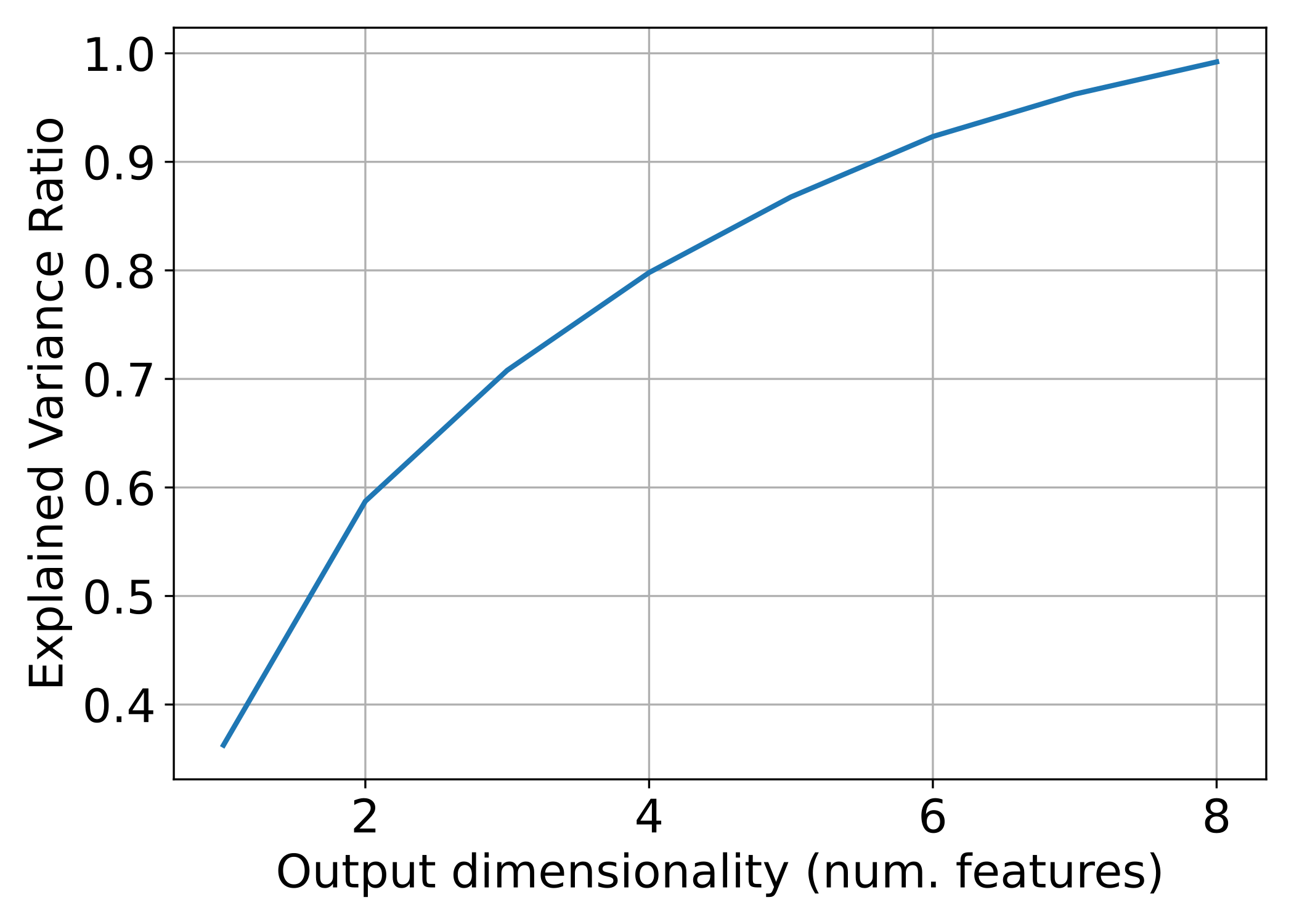
The relationship between the PCA-derived features and the aggregated explained variance ratio.
Finally, the image below represents how three different features were reduced
to a single one using PCA. The output point cloud can be exported using a
Writer component (see Writer documentation).
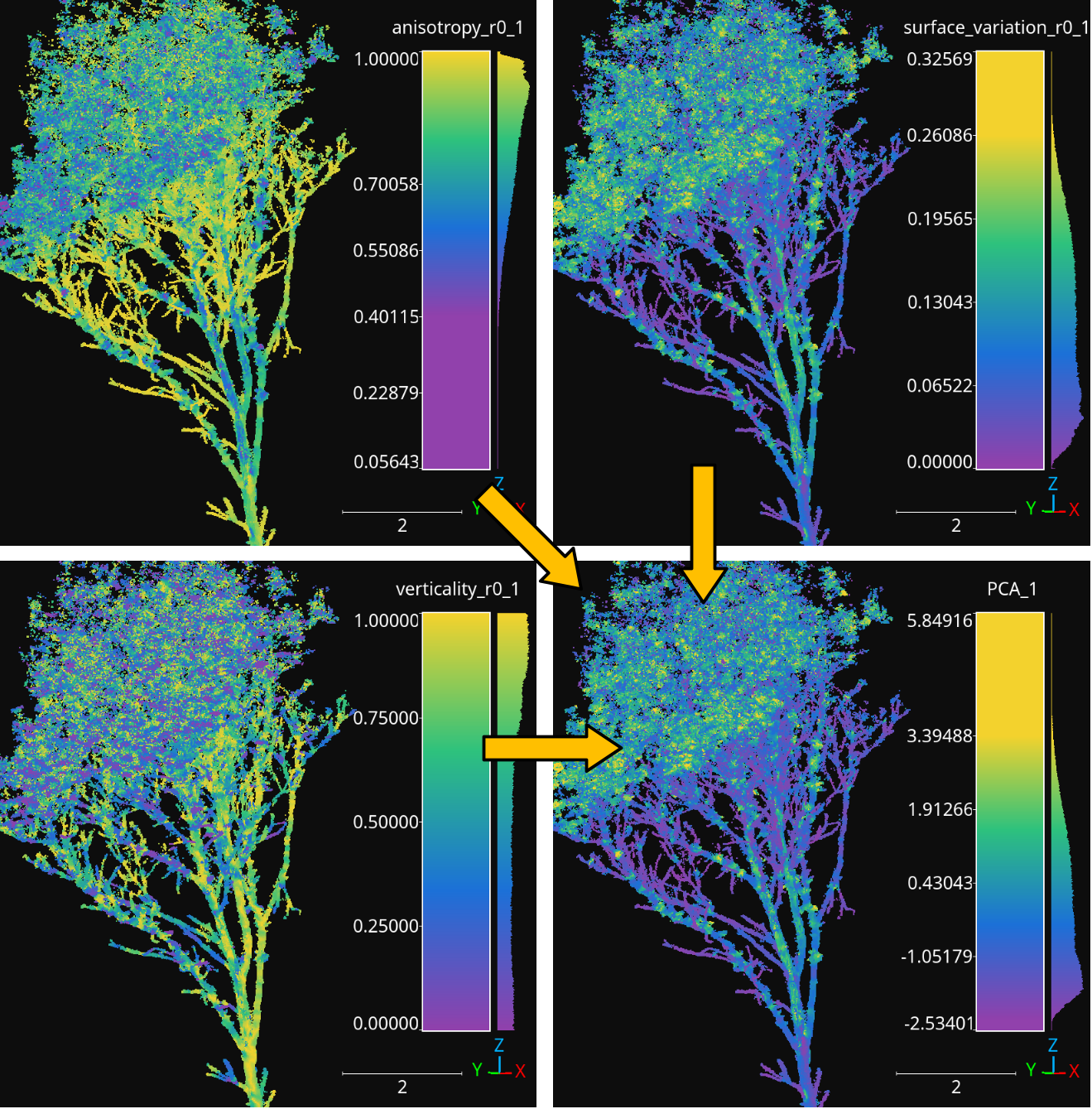
The anisotropy, surface variation, and verticality computed for spherical neighborhoods with \(10\,\mathrm{cm}\) radius reduced to a single feature through PCA.
Point transformers
Some point transformers like ReceptiveField or
DataAugmentor and their derived classes (e.g.,
ReceptiveFieldFPS, ReceptiveFieldGS,
ReceptiveFieldHierarchicalFPS, SimpleDataAugmentor
)are used in the
context of deep learning models. Thus, they are not available as independent
components for pipelines. Other point transformers, typically those that extend
PointTransformer can be used as components in pipelines and are
detailed here.
Point cloud sampler
The PointCloudSampler generates a new point cloud by sampling from
the current one (i.e., the point cloud in the pipeline’s state, see
documentation on pipelines). A
PointCloudSampler can be defined inside a pipeline using the JSON
below:
{
    "point_transformer": "PointCloudSampler",
    "neighborhood_sampling": {
        "support_conditions": [
            {
                "value_name": "HighCA_rel",
                "condition_type": "greater_than_or_equal_to",
                "value_target": 0.667,
                "action": "preserve"
            }
        ],
        "support_min_distance": 1.25,
        "support_strategy": "fps",
        "support_strategy_num_points": 100000,
        "support_strategy_fast": true,
        "support_chunk_size": 50000,
        "center_on_pcloud": false,
        "neighborhood": {
            "type": "sphere",
            "radius": 2.5,
            "separation_factor": 0
        },
        "neighborhoods_per_iter": 10000,
        "nthreads": -1
    }
}
The JSON above defines a PointCloudSampler that will generate a point
cloud considering spherical neighborhoods with radius \(2.5\,\mathrm{m}\)
centered on those points in the current point cloud with a relative frequency
of high class ambiguity neighbors greater than or equal to \(0.667\).
A point is said to have a high class ambiguity if it is greater than or equal
to \(0.667\). When sampling, all the center points that are close to each
other in less than \(1.25\,\mathrm{m}\).
Arguments
- –
fnames The names of the features that must be included in the sampled point cloud. If
null, then all the available features will be included.- –
neighborhood_sampling When
null, no neighborhood sampling will be applied. If given, it must be a key-word specification of the desired neighborhood sampling strategy, as described below:- –
support_conditions A list with the conditions that must be satisfied by any center point whose neighborhood could be included in the generated point cloud (provided it satisfies the other criteria). The specification for each conditions is similar to the one described in the conditions for advanced input documentation.
- –
support_min_distance When more there are many center points that are close to each other in less than this distance, only one will be considered.
- –
support_strategy If the support points are not calculated with a null separation factor, then the support strategy will be used to select the initial candidates. See the receptive fields documentation for further details because the specification works in the same way.
- –
support_strategy_num_points If the support points are not calculated with a null separation factor, and the
"fps"support strategy is used, then this number of points will govern the number of initially selected candidates. See the receptive fields documentation for further details because the specification works in the same way.- –
support_strategy_fast If the support points are not calculated with a null separation factor, fast heuristics can be applied to speedup the computations. See FPS receptive field documentation for further details.
- –
support_chunk_size When given and distinct than zero, it will define the chunk size. The chunk size will be used to group certain tasks into chunks with a max size to prevent memory exhaustion.
- –
center_on_pcloud When
truethe neighborhoods will be centered on a point from the input point cloud. Typically by finding the nearest neighbor of a support point in the input point cloud. In general, it is recommended to set it tofalsefor most use cases of thePointCloudSampler.- –
neighborhoods_per_iter When doing multiple iterations to compute the neighborhoods, the overlapping might yield many repeated points. However, there is no need to store repeated elements in memory (which can be prohibitive). When the number of neighborhoods per iter is set to be greater than zero, only this number of neighborhoods will be computed at once, thus controlling the required memory.
- –
nthreads The number of threads involved in parallel computations, if any.
- –
neighborhood The definition of the neighborhood. See the FPS neighborhood specification for further details because it follows the same format.
- –
type Supported neighborhood types are:
"sphere","cylinder","rectangular3d", and"rectangular2d".- –
radius A decimal number goverening the size of the neighborhood.
- –
separation_factor A decimal number governing the separation between neighborhoods. It it recommended to set it to zero so the custom support extraction strategy of the
PointCloudSampleris used.
- –
- –
Output
A point cloud is generated by sampling spherical neighborhoods from high class ambiguity regions in the original point cloud. The class ambiguity has been measured for a KPConv-like neural network model. The point cloud is taken from the Architectural Cultural Heritage (ArCH) dataset .
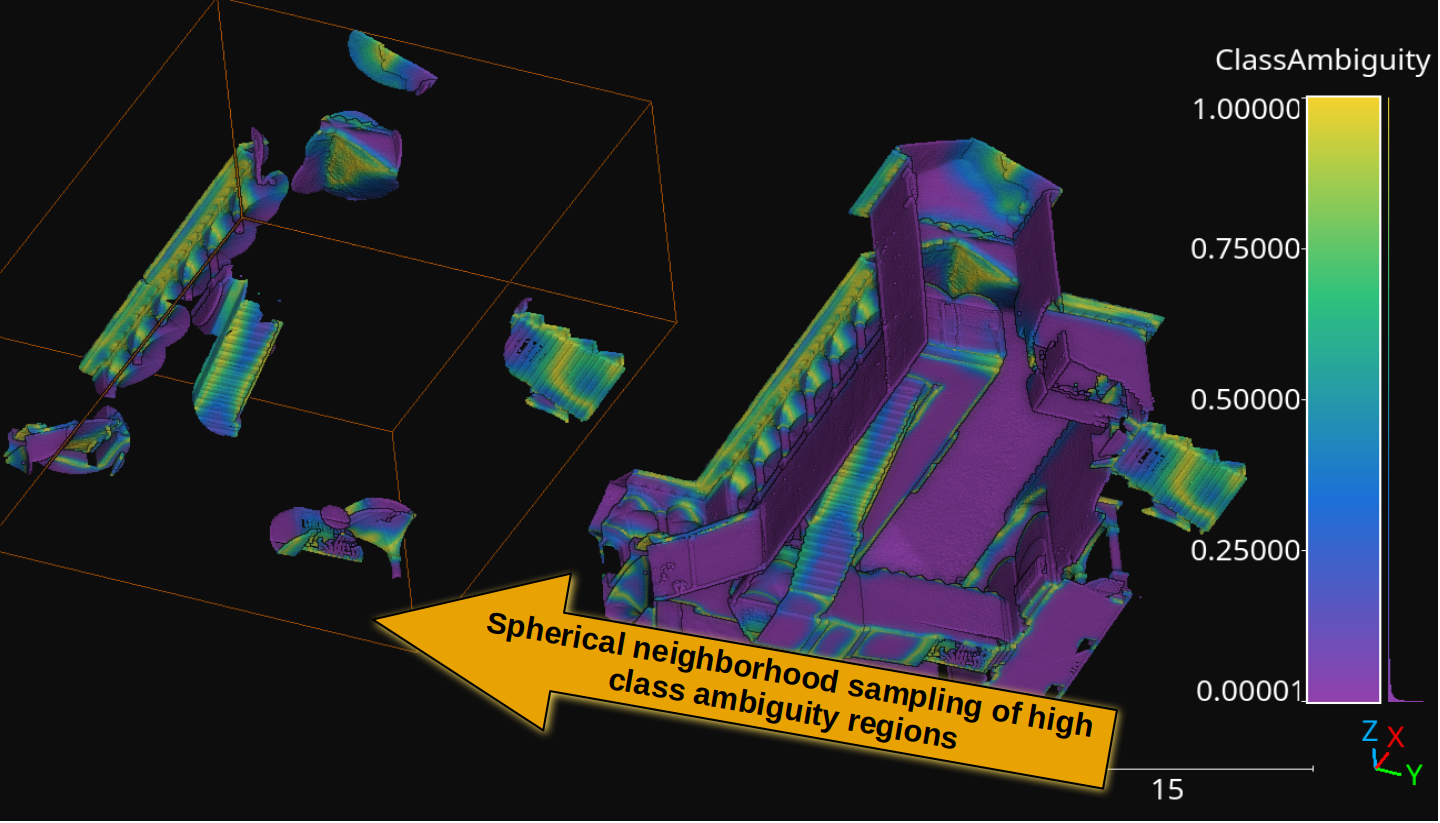
The spherical neighborhoods sampled from high class ambiguity regions (those inside the orange bounding box). The points are colored by class ambiguity.
Simple structure smoother++
The SimpleStructureSmootherPP generates a new point cloud by smoothing
the coordinates of each point considering its local neighborhood. A
SimpleStructureSmootherPP can be defined inside a pipeline using the
JSON below:
{
  "point_transformer": "SimpleStructureSmootherPP",
  "neighborhood": {
    "type": "sphere",
    "radius": 20,
    "k": 1024
  },
  "strategy": {
    "type": "idw",
    "parameter": 2,
    "min_distance": 4
  },
  "correction": {
    "K": 0,
    "sigma": 3.14159265358979323846264338327950288419716939937510
  },
  "nthreads": -1
}
The JSON above defines a SimpleStructureSmoother applied on spherical
neighborhoods with \(20\;\mathrm{mm}\) radius using inverse distance
weighting with \(p=2\) and \(\epsilon=4\). It does not use Fibonacci
orthodromic correction at all.
Arguments
- –
neighborhood The definition of the neighborhood.
- –
type The type of neighborhood. It can be either
"knn"(3D k-nearest neighbors),"knn2d"(2D k-nearest neighbors considering the \((x, y)\) coordinates only),"sphere"(spherical neighborhood), and"cylinder"(cylindrical neighborhood).- –
radius The radius for the sphere or the disk of the cylinder.
- –
k The number of k-nearest neighbors.
- –
- –
strategy The specification of the smoothing strategy.
- –
type The smoothing strategy. It can be either
"mean","idw"(Inverse Distance Weighting), or"rbf"(Radial Basis Function).- –
parameter The \(p \in \mathbb{R}\) parameter for the IDW exponent or the Gaussian RBF bandwith.
- –
min_distance The \(\epsilon \in \mathbb{R}\) parameter governing the min distance for IDW smoothing. Distances smaller than this will be replaced.
- –
- –
correction The configuration of the Fibonacci orthodromic correction.
- –
K The number of pionts in the spherical Fibonacci support. The greater the better but it will lead to higher execution times (i.e., it increases the computational cost).
- –
sigma The hard cut threshold for the Fibonacci orthodromic correction between a point in a centered neighborhood \(\pmb{x}_{j*} \in \mathbb{R}^{3}\) and a point from the Fibonacci support \(\pmb{q}_{k*} \in \mathbb{R}^{3}\).
\[\omega(\pmb{x}_{j*}, \pmb{q}_{k*}) = \max \left\{ 0, \sigma - \arccos\left(\dfrac{ \langle\pmb{x}_{j*}, \pmb{q}_{k*}\rangle }{ \lVert\pmb{x}_{j*}\rVert } \right) \right\}\]
- –
- –
nthreads The number of threads to be used for parallel computations (-1 means as many threads as available cores).
Output Smoother versions of a point cloud using the JSON above with different parameters. The input data comes from the Head and Neck Organ-at-Risk CT Segmentation Dataset (HaN-Seg) dataset.
The smoothed versions of a medical 3D point cloud representing the head and neck regions. Each color represents a distinct organ.